Quick answer
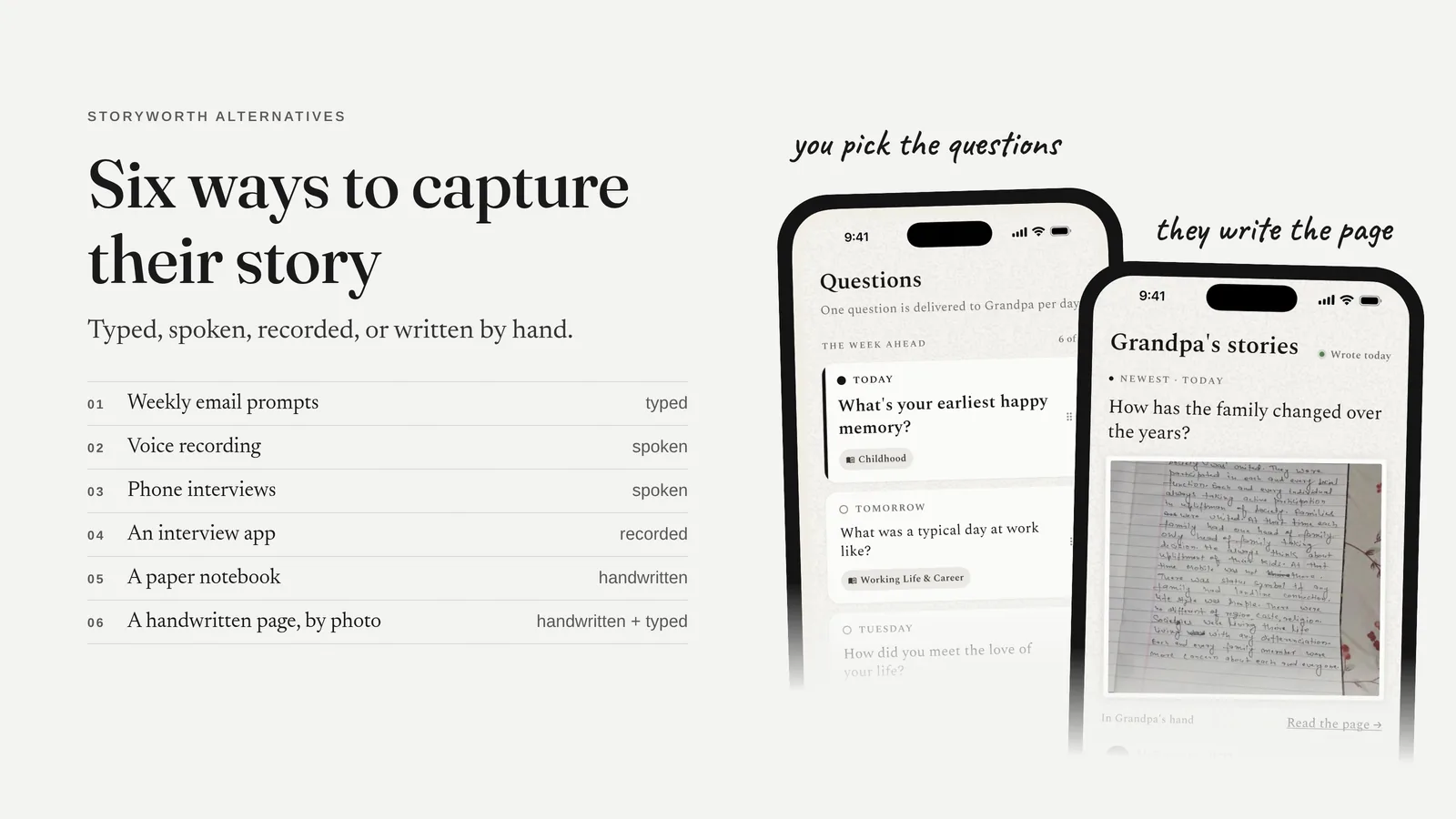
The best Storyworth alternative depends on how your parent likes to tell a story. Remento if they'd rather talk than type. Memorygram if you want phone interviews and a hardcover with no subscription. The free StoryCorps app for one recorded conversation. A plain notebook if you want zero tech. Longhand: Life Story Journal if they'd rather write by hand and you want to keep the actual page. And Storyworth itself is still a good pick if they're happy typing emails and you want a printed book at the end of the year.
I'm Sanket, and I make Longhand, one of the six options below. So yes, I have a horse in this race. I've tried to give each option a fair go and to say clearly who each one suits, including when Longhand isn't it. Everything about other companies comes from their own websites as I read them on 3 November 2026. Prices and plans change, so check the current listing before you buy.
Why do people look for a Storyworth alternative?
Storyworth is the best-known name here for good reason: a question arrives each week, your parent replies, and at the end of the year the stories become a hardcover book. People who look elsewhere usually have one of four reasons.
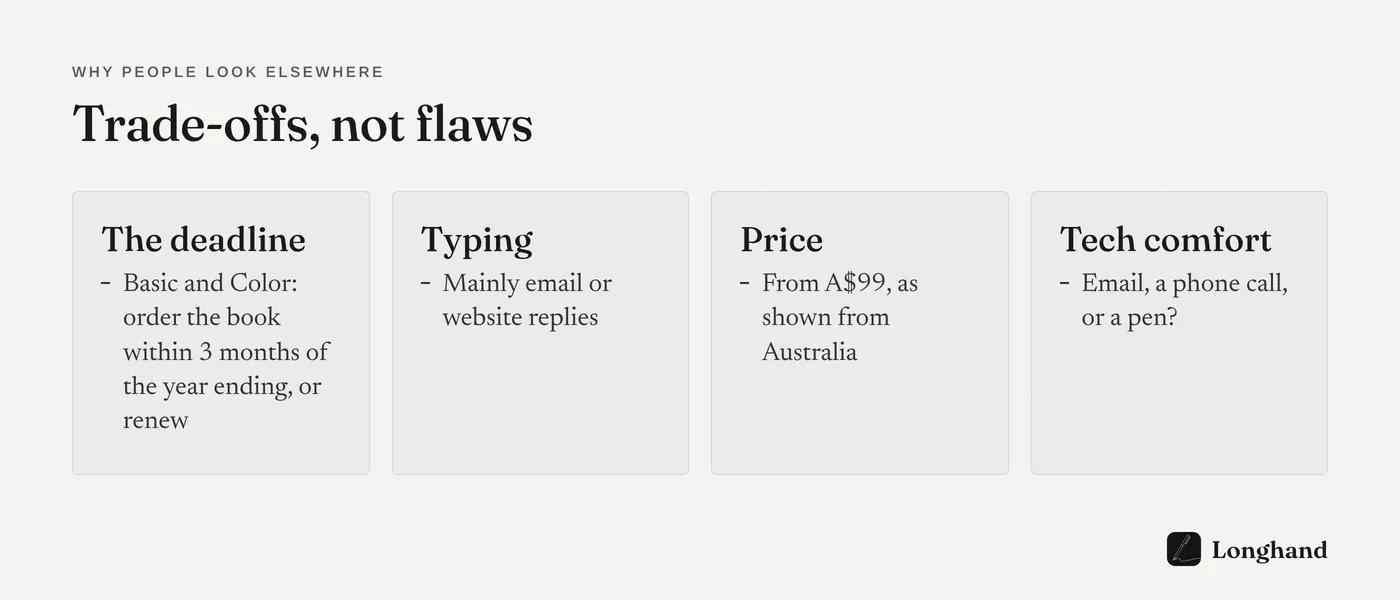
- The deadline. On Storyworth's Basic and Color plans, its FAQ asks you to order your book within three months of the year ending, or renew. That's a sensible structure, but some families would rather not have a clock running.
- Typing. The main way to answer is by replying to an email or writing on the Storyworth website. Storyworth also has phone options (its plan page lists voice recording on every plan, while its FAQ says phone calls are for upgraded plans). Still, it's a writing-first product, and plenty of parents don't love typing.
- Price. Plans start at A$99 as shown to me from Australia, with A$189 and A$339 tiers above that. That's fair value for a year and a book, but still a gift-sized purchase.
- Tech comfort. Some parents are fine with email. Others would much rather talk on the phone, or pick up a pen.
These are trade-offs rather than flaws, and a different format might simply suit your parent better.
How do you choose the right option for your parent?
Four questions narrow it down fast.
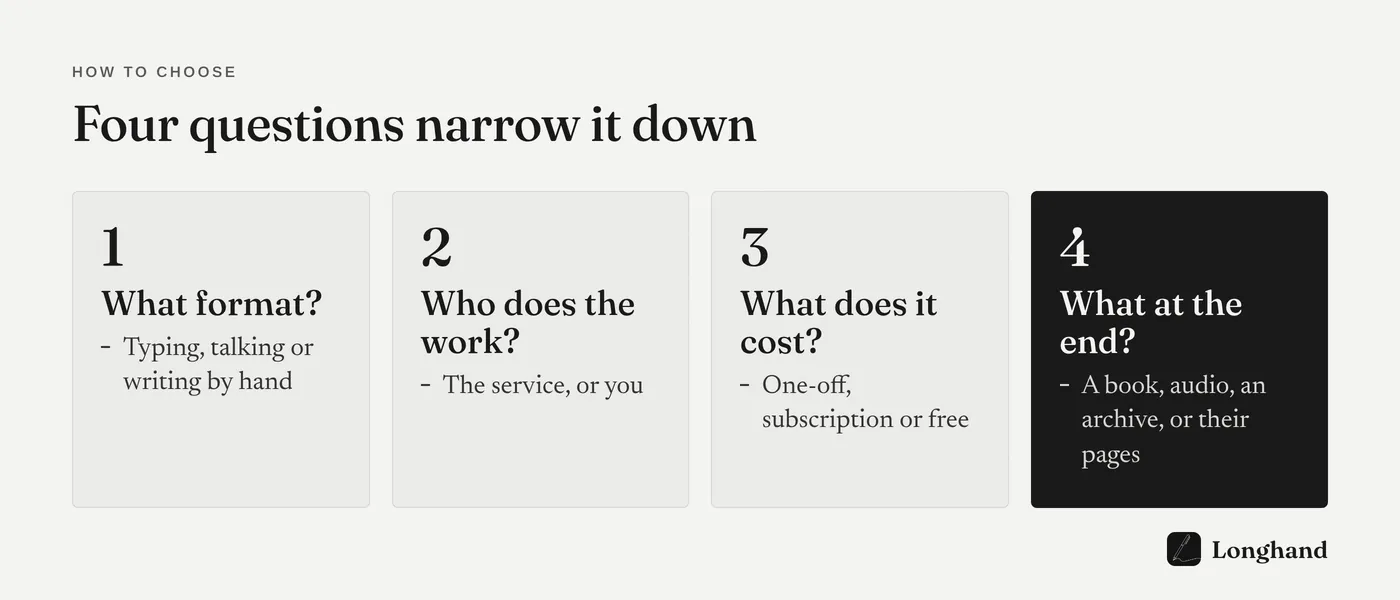
- What format suits them? Typing, talking or writing by hand. A great talker will give you more over the phone than in an email; a letter-writer will give you more on paper.
- Who does the work? Some services send the questions and chase the answers for you. Others (a notebook, the StoryCorps app) need you to drive it.
- What does it cost, and how? A one-off purchase, a subscription, or free.
- What do you want at the end? A printed hardcover, audio recordings, a digital archive you can search, or the original pages in their handwriting.
What are the 6 best Storyworth alternatives?
Six options, Storyworth included for comparison, in no particular order.
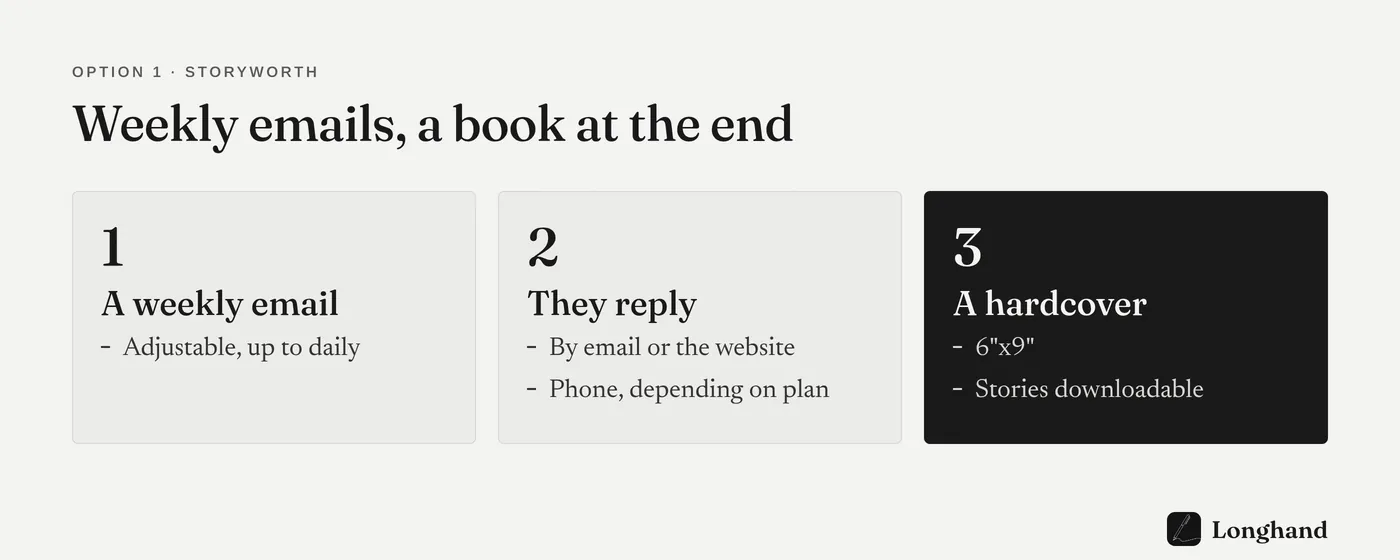
1. Storyworth: weekly emails, a book at the end
- How it works: Storyworth emails a question each week. You can change how often, up to once a day. Your parent replies by email or on the website, or by phone depending on the plan, and can add photos.
- Best for: parents who are comfortable writing emails, and families who want a classic printed memoir.
- Price: A$99 (Basic, black-and-white book), A$189 (Color) or A$339 (Unlimited, A$169 annual renewal), as shown from Australia. There's a 30-day money-back guarantee if no books have been printed.
- What you end up with: a 6"x9" hardcover book. Storyworth says your stories are also available to download free.
2. Remento: they talk, it becomes a book
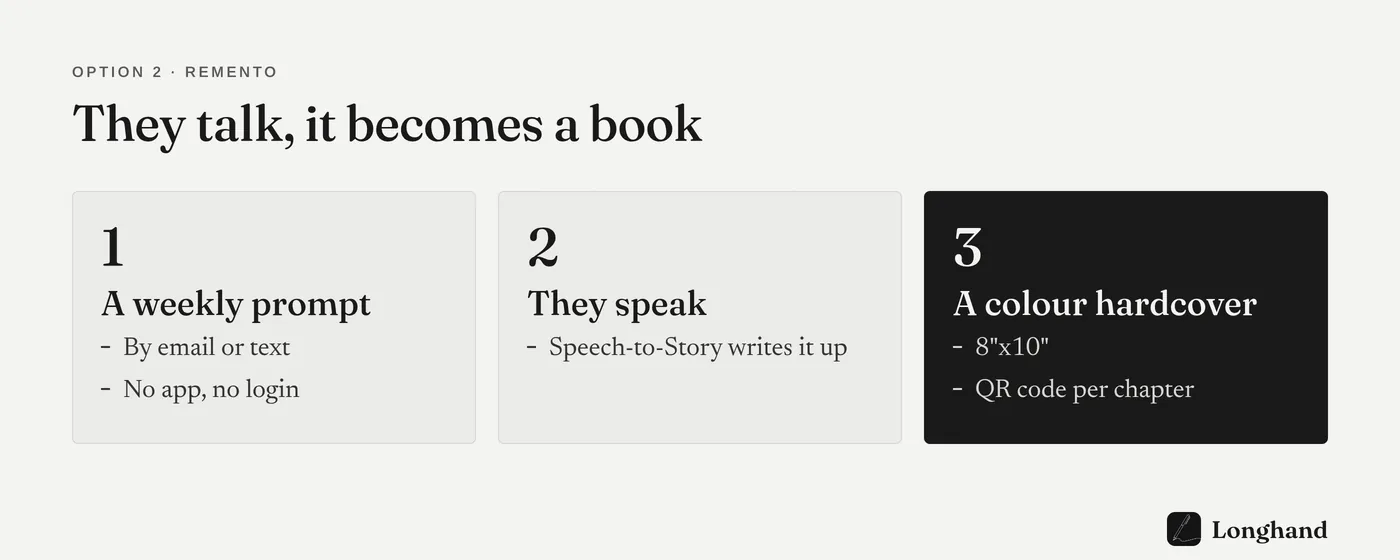
- How it works: a weekly prompt arrives by email or text, and your parent records their answer out loud. Remento says there's no app to download and no login. Its "Speech-to-Story" feature turns the recording into a written chapter, either word for word or polished, and you can edit it.
- Best for: natural talkers, and families who want to hear the voice as well as read the words.
- Price: its homepage lists $99 for the first year plus one book, then optional renewal. Prices showed in A$ on its FAQ when I checked from Australia.
- What you end up with: a full-colour 8"x10" hardcover with a QR code on each chapter that plays the original recording. Remento says the recordings stay viewable even if you don't renew.
If you're weighing up those two, I've compared them in detail in Remento vs Storyworth vs Storii vs Longhand. For a closer look at Storii on its own, see Storii vs Longhand: voice calls or handwritten pages?.
3. Memorygram: phone interviews, no subscription
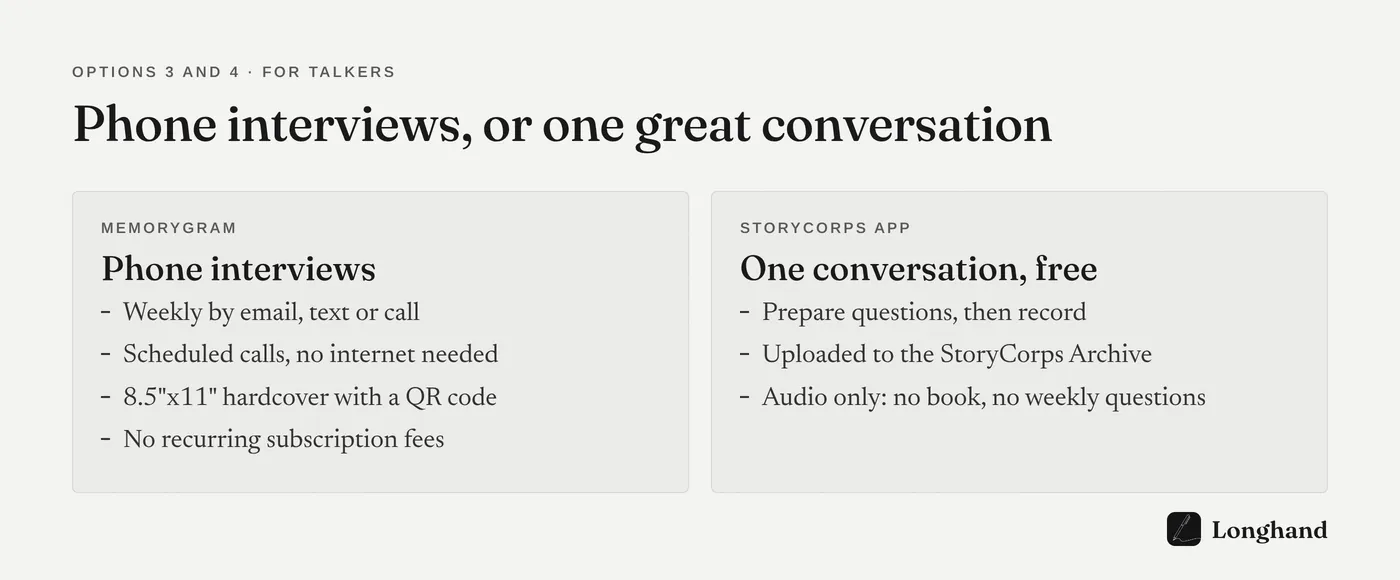
- How it works: questions arrive weekly by email, text or phone call. Your parent can answer by typing, by voice-to-text, by text message, or by talking to Memorygram's phone interviewer. You can schedule weekly phone calls that don't need an internet connection, and Memorygram says any phone works, even a landline.
- Best for: parents who'd rather chat on the phone, and families who don't want a subscription.
- Price: it showed a sale price of $99 when I checked, with "no recurring subscription fees". It was a time-limited sale, so check the current price.
- What you end up with: a full-colour 8.5"x11" hardcover, with a QR code inside that plays their voice. Memorygram also offers books with multiple storytellers.
4. The StoryCorps app: one great conversation, free
- How it works: StoryCorps' free app helps you prepare interview questions, record a conversation on your phone, and upload the audio to the StoryCorps Archive and the Library of Congress.
- Best for: sitting down together for one long, proper interview, especially if you like the idea of it being kept in a public archive.
- Price: free on the App Store.
- What you end up with: an audio recording of your conversation. There's no book, and no weekly questions. Read how the archive works before you upload, so you know who will be able to hear it.
5. A DIY notebook: no tech at all
- How it works: buy a good notebook, write one question at the top of each page (our 100 questions to ask your parents is a good place to start), and give it to them.
- Best for: parents who love paper and want nothing to do with apps, and families who live close enough to hand it over.
- Price: whatever the notebook costs.
- What you end up with: the notebook itself, in their handwriting, which is lovely. The catch: it's a single copy, nobody else sees it until it's finished, and notebooks easily sit in a drawer half done. Scan pages as you go.
6. Longhand: Life Story Journal: a handwritten page, by photo
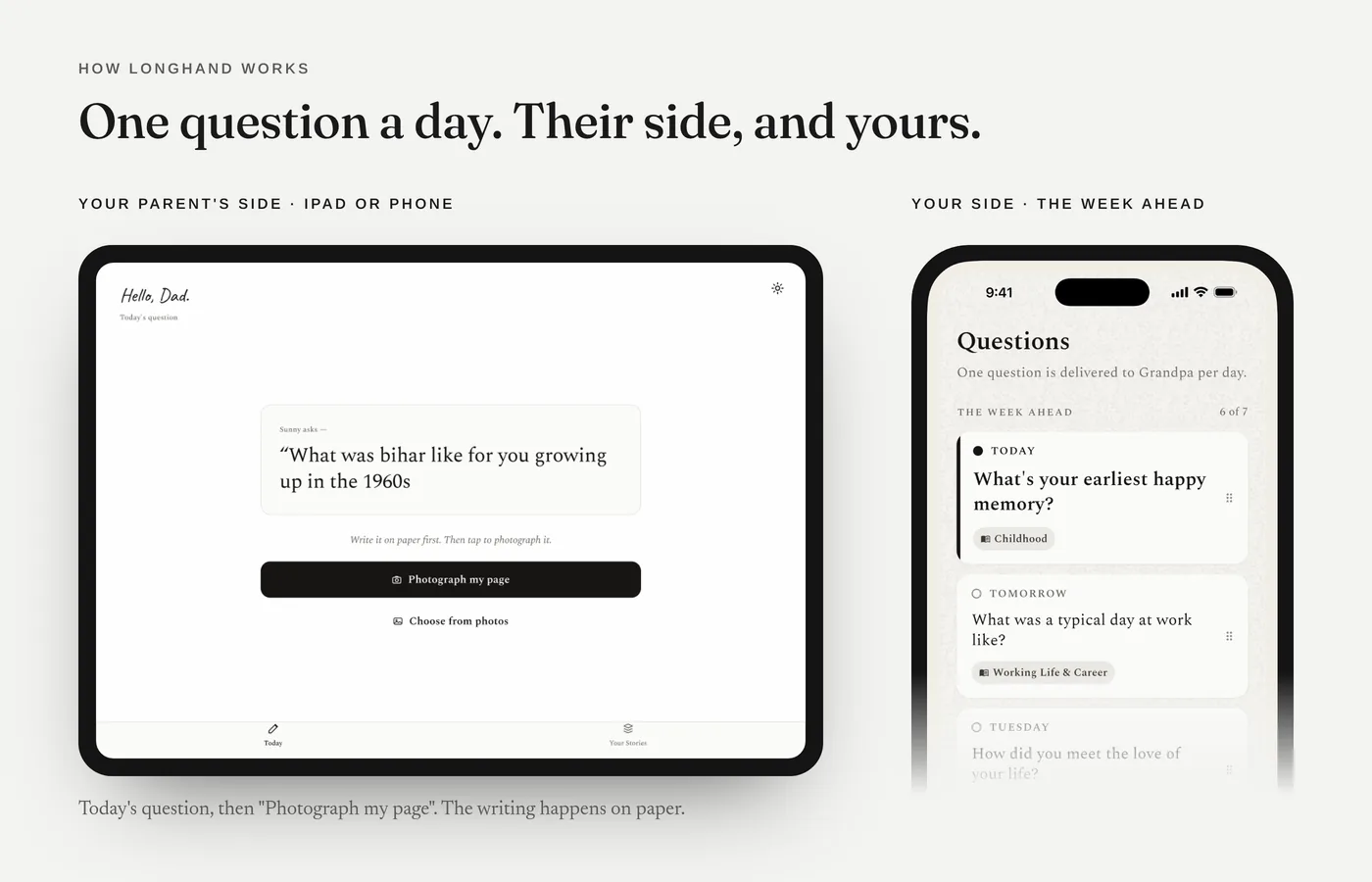
- How it works: you choose the questions from prompt packs (Childhood, Love, Work, Hard Times, Wisdom) or take personalised suggestions. Your parent gets one question a day, writes the answer on paper and takes a photo in the app. AI transcribes the page so it's readable and searchable. You get the page itself, the typed copy, and an optional voice note, as each answer arrives. It runs on iPhone, iPad and Android. The app, its questions and its reminders come in 16 languages (English, Hindi, Chinese (Simplified and Traditional), Spanish, French, German, Dutch, Punjabi, Tamil, Sinhala, Vietnamese, Japanese, Arabic, Urdu and Hebrew). It reads handwriting in each of them, and you and your parent can each use your own.
- Best for: parents who think better with a pen, parents who'd rather not write in English, families who live far apart, and anyone who wants the handwriting itself kept.
- Price: free right now during early access, while I learn from the first families using it. It will become a paid subscription; I haven't announced the price yet. When it does, one subscription per parent will cover both sides, and your archive will stay viewable and exportable if you stop paying.
- What you end up with: a growing archive of handwritten pages with typed copies, plus a PDF you can send to yourself and get printed anywhere you like. A printing partner is coming soon. Until then, Longhand doesn't print books itself.
How do the six options compare?
| Option | How they answer | Who does the work | Cost (as of Nov 2026) | What you end up with |
|---|---|---|---|---|
| Storyworth | Email or website; phone options vary by plan | Storyworth sends questions weekly (adjustable) | One-off plans from A$99 (shown from Australia) | 6"x9" hardcover; stories downloadable |
| Remento | Speaks a voice answer | Remento sends weekly prompts | $99 first year + one book, then optional renewal | 8"x10" colour hardcover with QR codes to recordings |
| Memorygram | Typing, voice-to-text, text message or phone interviewer | Memorygram sends weekly; scheduled calls | Sale price $99 when checked; no subscription | 8.5"x11" colour hardcover with a QR code for their voice |
| StoryCorps app | A recorded conversation | You prepare and run the interview | Free | Audio recording, uploaded to the StoryCorps Archive |
| DIY notebook | Handwriting | You, entirely | A notebook | One handwritten original |
| Longhand: Life Story Journal | Handwriting, photographed in the app (+ optional voice note) | You pick questions; the app delivers one a day | Free during early access; it will become a paid subscription later | Handwritten pages + typed copies; PDF to print anywhere (printing partner coming soon) |
From each company's own website and App Store listing, read 3 November 2026. Some prices showed in Australian dollars because I checked from Australia. Longhand is free only while it's in early access, so its row isn't a like-for-like price comparison yet. Check the current listing before you buy. Sources: Storyworth FAQ, Remento FAQ, Memorygram, StoryCorps app.
Why did I build Longhand?
I live in Australia. My dad lives in India, retired and on his own, a long flight away. I call him every day, but he's never been a big talker, and some evenings we'd both run out of things to say.
So I started sending him one small question a day. He writes the answer by hand and shares the page with me, so by the time we talk I have something real to ask him about. It changed our calls. He was Longhand's first writer, and the app is really just that habit with the fiddly bits taken care of.
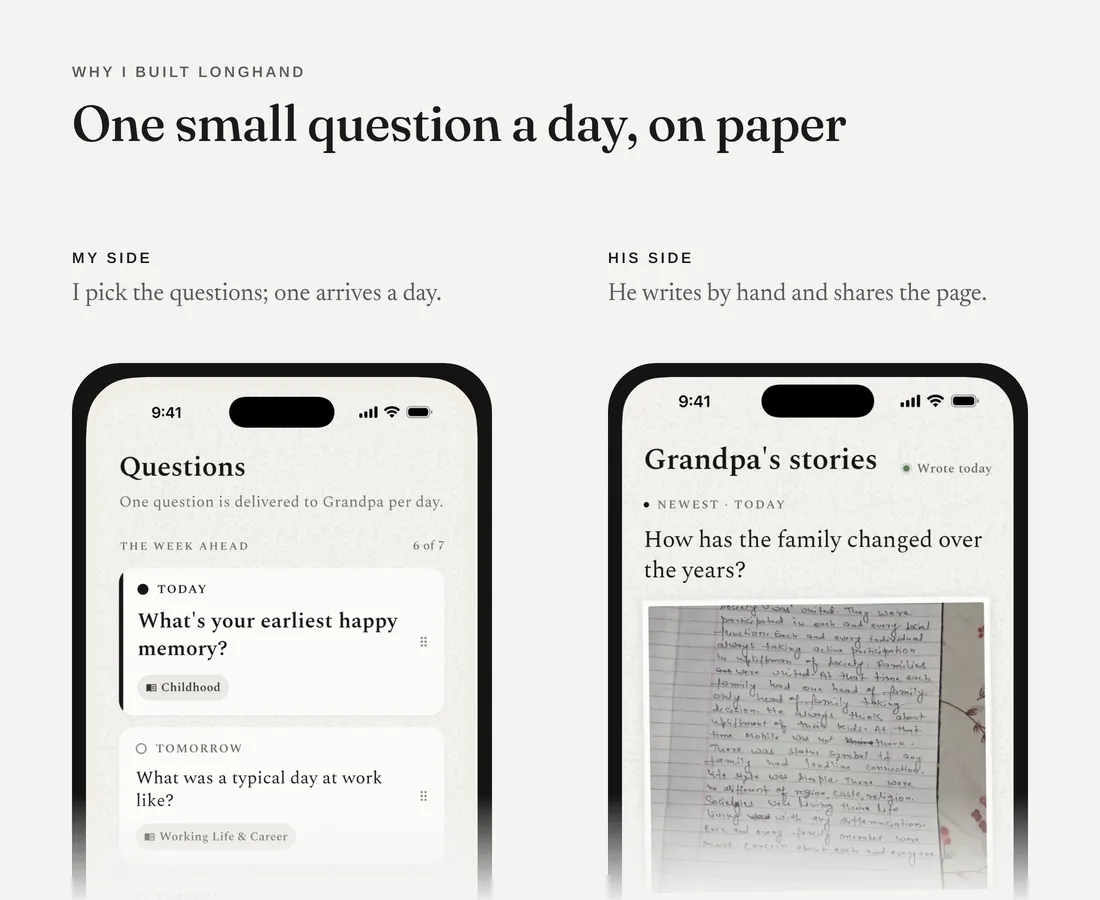
That's why Longhand works the way it does. It's one small question a day, not a weekly assignment. It's answered on paper, because a story in your dad's handwriting isn't the same as the same story in a typeface. The typed copy is there so the rest of the family can read it and search it. And because plenty of our parents don't tell their stories in English, the app comes in 16 languages. If your parents live far away too, I wrote more about that in when your parents live far away.
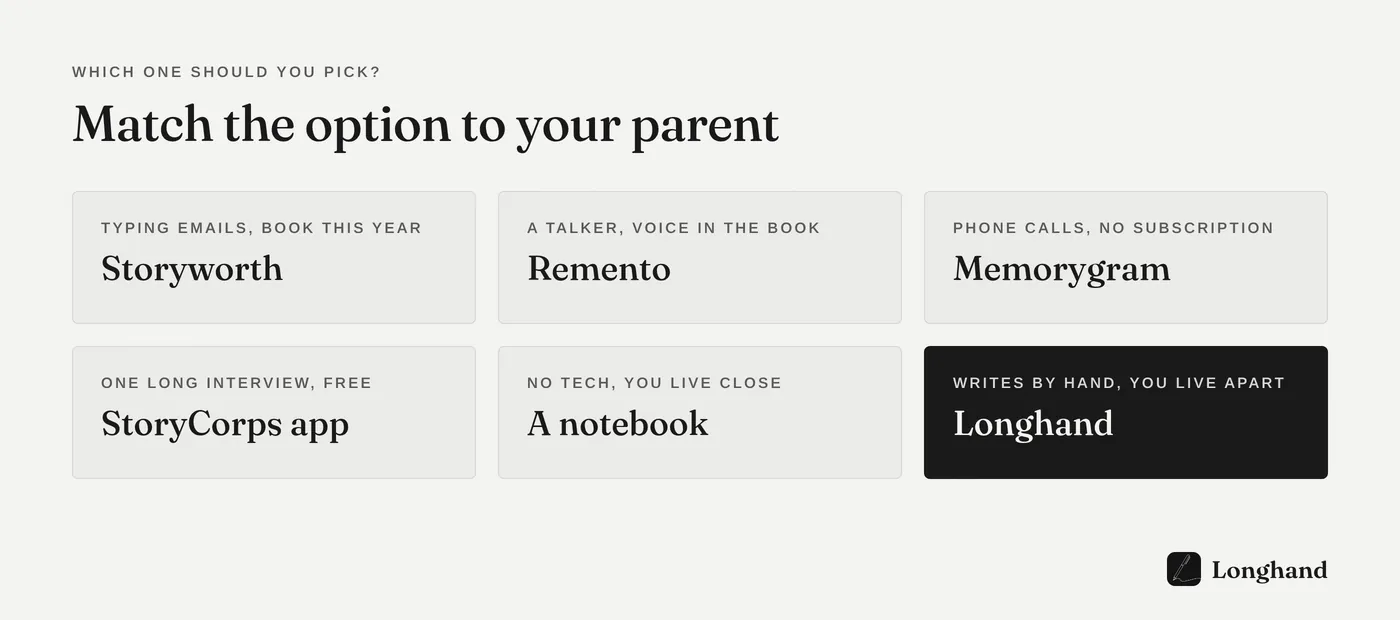
Which one should you pick?
- They're happy typing emails, and you want a printed book this year: Storyworth.
- They're a talker, and you want their voice in the book: Remento.
- They'd rather be phoned, and you don't want a subscription: Memorygram.
- You want one long, proper interview, free: the StoryCorps app.
- No tech at all, and you live close by: a notebook.
- They like writing by hand (in English or one of 15 other languages), you live apart, and you want the actual page kept: Longhand: Life Story Journal.
When Longhand isn't the one. If writing by hand is hard for your parent (arthritis, a tremor, poor eyesight), go with a voice option. Pick something else too if they won't use a phone or tablet camera at all, or if you need a bound book in your hands soon, because for now you'd be printing Longhand's PDF yourself, until its printing partner arrives.
Start with one question today.
Longhand: Life Story Journal is free during early access, before it becomes a paid subscription. Pick a question tonight; they answer on paper.


Disclosure: I make Longhand: Life Story Journal. Storyworth, Remento, Memorygram and StoryCorps are other organisations, and they haven't reviewed this page. Spotted something out of date? Email development@digitalsauce.io and I'll fix it.
What else do people ask?
Is Storyworth a good fit for my parent?
For many families, yes. If your parent is comfortable writing emails and you want a printed hardcover at the end of the year, it's a well-established, simple way to get there. It's less of a fit if your parent would rather talk or write by hand, or if you don't want to work to a book deadline. Check its current plans and prices before you buy. Our Storyworth review covers its cost, pros and cons in full.
Remento vs Storyworth: which is better?
Remento is built around speaking: your parent records answers out loud and the book links to the recordings. Storyworth is built around writing, with phone options that vary by plan. Pick the one that matches how your parent likes to tell a story. There's a full side-by-side in our Remento vs Storyworth comparison.
What if my parent hates technology?
Choose an option where they barely touch it. Memorygram can phone them, even on a landline. A paper notebook needs no tech at all. With Longhand: Life Story Journal, the writing happens on paper and they only take a photo in the app, which has large type and no streaks to keep up with.
Is there a free Storyworth alternative?
Yes. The StoryCorps app is free and helps you record one guided conversation. A notebook costs only the notebook. Longhand: Life Story Journal is free during early access, and will become a paid subscription later.