A lifetime in their own words
One day you'll wish you'd asked.
Send your mum, dad, or grandparent one small question a day. They answer by hand — keeping their mind active and their story alive — and every call you make has something real to talk about.


Available now on iPhone, iPad & Android — free for early users.
Today's question
What's the first home you remember?
A little weatherboard house on Mostyn Street. The back step stayed warm all afternoon, and Mum kept her geraniums in old paint tins by the door…
The stories you'd regret never asking for — in their own hand, and in their own words.

How it works
Three quiet steps. No technology to learn.
You choose the questions
Pick from gentle, beautiful prompts — or let Longhand suggest ones made personal to their life. Set the week ahead; they receive just one a day.
They write by hand
On real paper, the way they always have. A photo is all it takes — Longhand keeps the page, and AI transcribes every word so it stays readable and searchable forever.
You receive their stories
Each answer arrives as it's written, building a living archive of a life. Read it on your phone — then call them to talk about it.

The difference
Their actual handwriting. Not a typeface.
Typing forgets the hand that wrote it. Longhand keeps the real page — the loops, the crossings-out, the press of the pen — as the keepsake. Then AI quietly reads and transcribes every word, so the story is searchable, printable, and yours to keep forever — even decades from now.
The page is the soul. The transcript makes sure it's never lost.
A page, kept
We were married in the little church at the top of the hill. It rained, and your grandmother said that meant luck…
Transcribed by AI · searchable & yours forever
Why it works
Gentle for the mind. Good for the heart.

Remembering
Recalling and reflecting on life stories is associated with improved mood, life satisfaction, and a sense of purpose in older adults.
Writing by hand
Writing by hand engages broader brain networks tied to memory and learning than typing does.
Staying connected
Staying connected across generations is linked to lower loneliness and greater well-being in later life.
A pen is a small thing. But in an older hand, it sets a whole person in motion.
Memory & recall
Each morning's question sends them back through their own life. Recalling and reflecting on life stories is associated with improved mood, life satisfaction, and a sense of purpose in older adults1 — strongest when practised regularly. That's why Longhand is one question a day, not a project for someday.
A wider-awake brain
Brain-imaging research shows handwriting engages far more widespread, interconnected brain networks than typing2 — including regions involved in laying down memory. When they answer by hand, more of them comes along.
The writing hand
Handwriting weaves attention, language, memory, motor planning, and fine motor control into one practised movement3 — a quiet daily workout for the kind of everyday dexterity worth keeping.
Imagination
Memory and imagination share the same machinery4: the mind that vividly retells the past is exercising the very processes it uses to picture and plan. A daily page isn't nostalgia — it's a mind kept in motion.
No streaks. No scores. No screens to learn. Just a question, a pen, and the feeling that their family wants to know.
References
- Pinquart, M., & Forstmeier, S. (2012). Effects of reminiscence interventions on psychosocial outcomes: A meta-analysis. Aging & Mental Health, 16(5), 541–558. doi.org/10.1080/13607863.2011.651434
- van der Weel, F. R., & van der Meer, A. L. H. (2024). Handwriting but not typewriting leads to widespread brain connectivity: a high-density EEG study with implications for the classroom. Frontiers in Psychology, 14, 1219945. frontiersin.org
- Mueller, P. A., & Oppenheimer, D. M. (2014). The pen is mightier than the keyboard: Advantages of longhand over laptop note taking. Psychological Science, 25(6), 1159–1168. pubmed.ncbi.nlm.nih.gov/24760141
- Schacter, D. L., Addis, D. R., & Buckner, R. L. (2007). Remembering the past to imagine the future: the prospective brain. Nature Reviews Neuroscience, 8, 657–661. nature.com/articles/nrn2213
- Baikie, K. A., & Wilhelm, K. (2005). Emotional and physical health benefits of expressive writing. Advances in Psychiatric Treatment, 11(5), 338–346. doi.org/10.1192/apt.11.5.338
- Holt-Lunstad, J., Smith, T. B., Baker, M., Harris, T., & Stephenson, D. (2015). Loneliness and social isolation as risk factors for mortality: A meta-analytic review. Perspectives on Psychological Science, 10(2), 227–237. doi.org/10.1177/1745691614568352
Longhand is designed to support cognitive engagement and family connection. It is not a medical device and is not intended to diagnose, treat, cure, or prevent any disease or condition, including dementia or cognitive decline. Research is cited as supporting evidence for the general benefits of reminiscence, handwriting, and connection — not as a promise of any individual outcome.
A living archive
Not a book with a deadline.
Most memoir gifts end the moment a book ships. Longhand doesn't. The stories keep coming for as long as they're writing — a collection that grows because they're still here.
And whenever you want it in your hands, download a clean, print-ready PDF — a chapter, a year, or the whole story — and print it yourself at home or your local print shop. A professionally printed, bound keepsake service is coming soon.

Print it yourself
A chapter. A year. A lifetime.
Export a beautifully laid-out PDF anytime and print it however you like. A printed-and-bound keepsake you can order in a tap is coming soon.
Built for them
Designed for your parent — not retrofitted.
Most older adults feel technology wasn't built for them. Longhand is. Large, calm type. One clear thing to do on every screen. No clutter, no jargon, and no streaks to guilt anyone.
If they can take a photo, they can use Longhand.
On their side of the app
"Mum, tell me your story."
One large question. One obvious next step. Nothing that feels like technology.
A look inside
Two sides of one quiet ritual.
One large, calm screen for them. A living archive for you. They answer today's question by hand; you read it the moment it's written — each page transcribed by AI so it stays searchable, and yours, forever.
Coming soon — add multiple family members, so the whole family can ask questions and read along together.
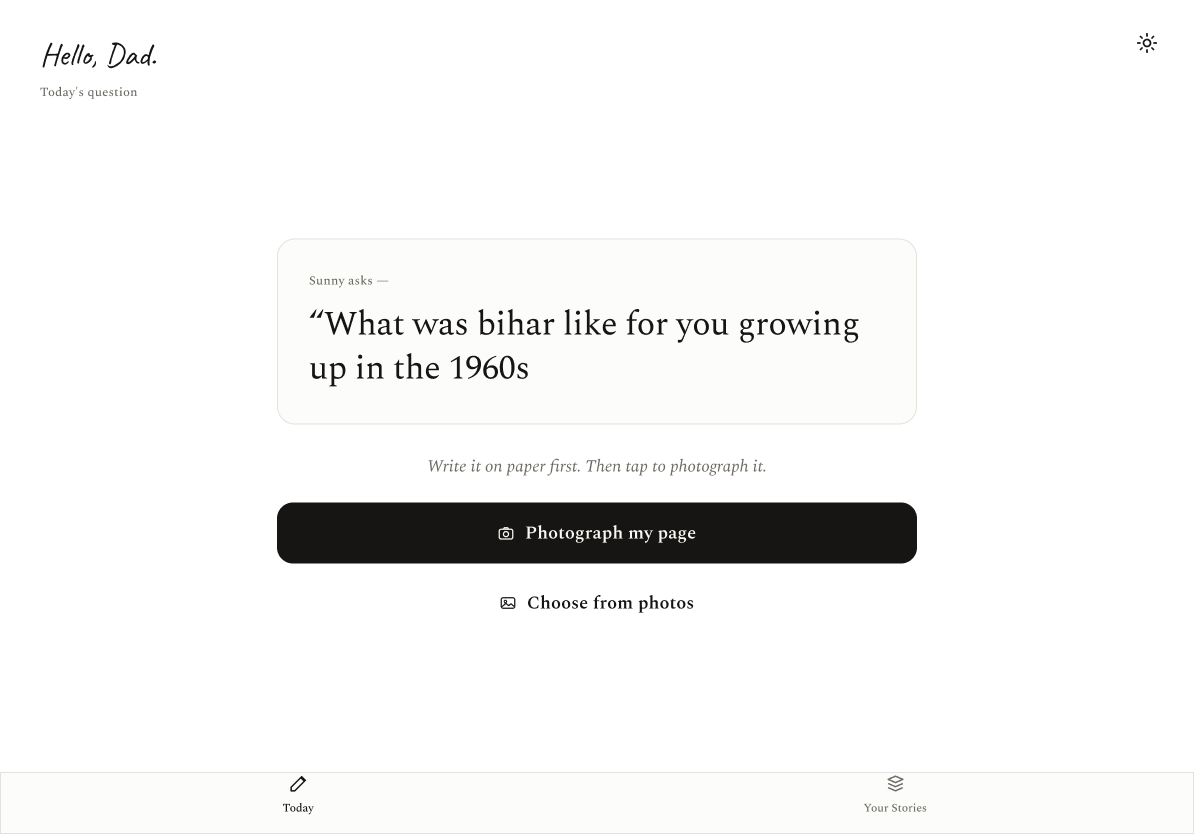
What they see. One question a day, one obvious tap. Nothing that feels like technology.
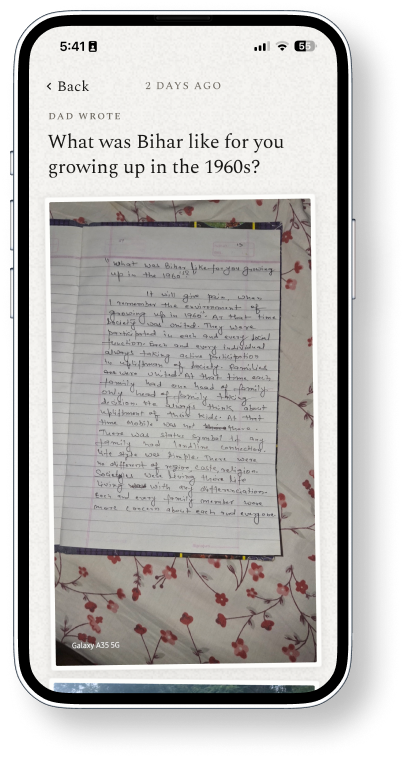
What you see. Their pages arrive as they're written — a living book that keeps growing.
From the maker
Why I built Longhand.
I live in Australia. My father lives in India — retired, and on his own. I call him every single day, but he was never a big talker, and some evenings we'd both go quiet, having run out of things to say.
What worried me most was how little there was to keep his mind active. So I started sending him one small question a day. He writes the answer out by hand — thinking, remembering, putting pen to paper — and shares it with me. By the time we talk, I have something real to ask him about, and he has something he's quietly proud to have written.
It changed our calls. That's the whole reason Longhand exists: not to replace the phone call, but to give it something to be about — and to keep a parent's mind, and their stories, close for a little longer.
If you have someone far away, or quiet, or simply worth remembering, I built this for you too.

Sanket
Maker of Longhand · built in Australia, for my dad in India
Be first
Give the gift of a story told by hand.
Some gifts you give before the chance passes. Longhand is here on iPhone, iPad and Android — and it's free for early users. Download it today.
Free for early users.
Download Longhand now and use it free while we’re in early access.
Free on iPhone, iPad & Android.
Sharing with a parent? Send them Longhand's download page.
Want Longhand news? Join the list and we'll keep you posted:
No spam, ever — just the occasional note about Longhand. Unsubscribe anytime.
Thank you — you're on the list.

Questions
The things families ask first.
Does my parent need to be good with technology?
No. If they can take a photo, they can use Longhand. Their side of the app shows one question and one clear action — nothing that feels like tech.
Can I get the stories printed?
Right now you can download a print-ready PDF of any stories — a chapter, a year, or everything — and print it yourself, as often as you like. A professionally printed, bound keepsake you can order in-app is coming soon.
What does it cost?
Longhand is free for early users. Download it on the App Store or Google Play and send your first question today. Exporting a print-ready PDF of your stories is included.
Can more than one of us take part?
Soon, yes. Support for adding multiple family members is coming — so siblings and grandchildren can all ask questions and read along in the same shared archive.
Which devices does it work on?
iPhone, iPad, and Android — available now on the App Store and Google Play. More platforms and regions to follow.
What if they miss a day, or don't write back?
That's completely fine — no streaks, no guilt. Longhand sends one gentle reminder when a question is waiting, then lets it rest. Some days they'll fill a page; some days they won't. The question simply waits until they're ready.
Is this really for them, or just for me?
Both. You get their stories and an easier, warmer phone call. They get a small daily reason to sit, think, remember, and write — and the quiet pride of knowing their family wants to hear it. It's designed to be good for the person answering, not only the one collecting.