Quick answer
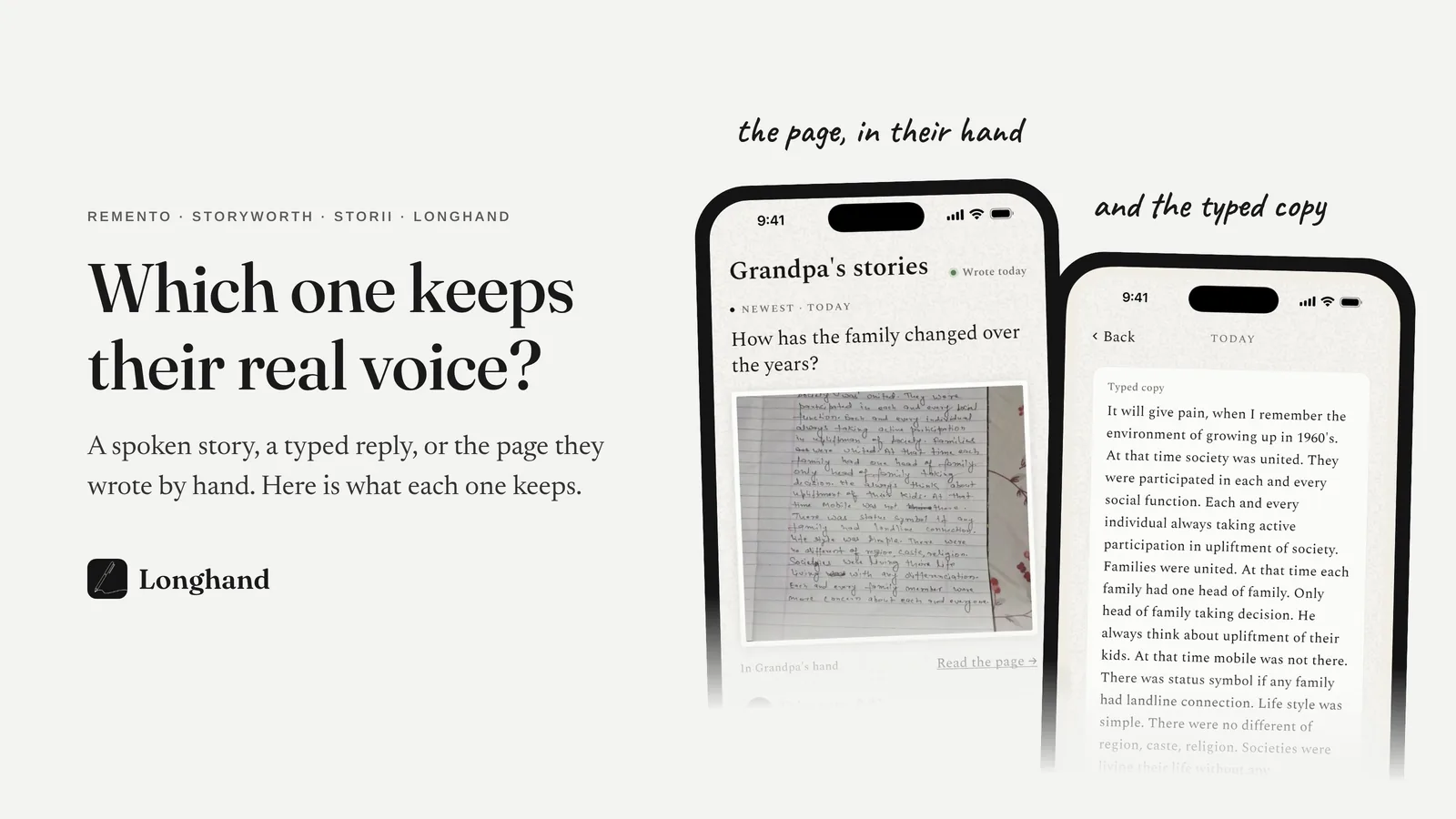
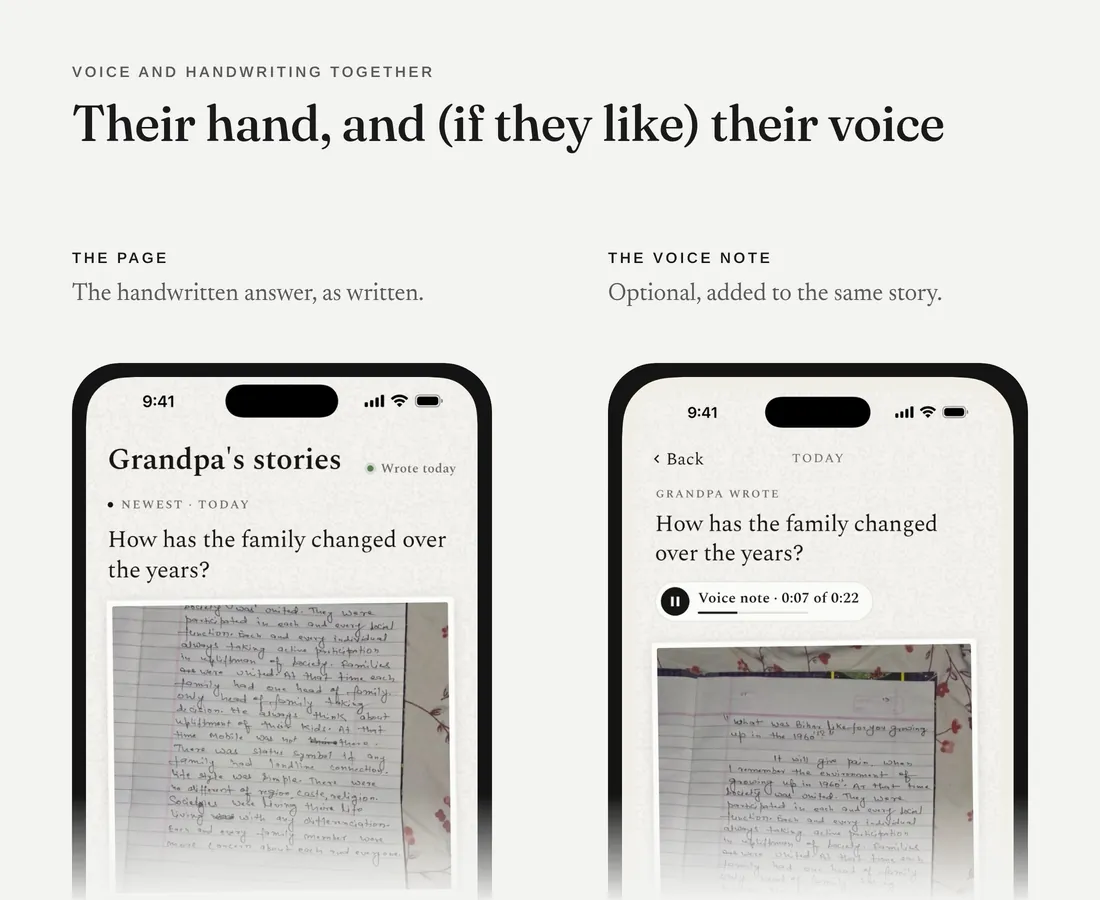
If "their real voice" means hearing them, Remento is the most voice-centred: your parent talks, Remento turns it into a written chapter, and each chapter in the book gets a QR code that plays the recording. Storii also captures their spoken voice, over an ordinary phone call. Storyworth is mostly typed answers by email or on its website, with phone recording options that vary by plan, and its strength is the printed hardcover. Longhand: Life Story Journal (my app) is the only one of the four that keeps their handwriting: they answer on paper, and you get a photo of the page, a typed copy and an optional voice note.
I built Longhand, so read this with that in mind. I've tried to be straight about where each one wins, including where Longhand isn't the right pick. Everything here about Storyworth, Remento and Storii comes from their own websites as I read them on 3 November 2026. Plans change, so check the current listing before you buy.
How does each one capture a parent's stories?
All four send your parent questions about their life. The big difference is how the answer comes back: spoken, typed or handwritten. That one choice decides what you end up keeping.
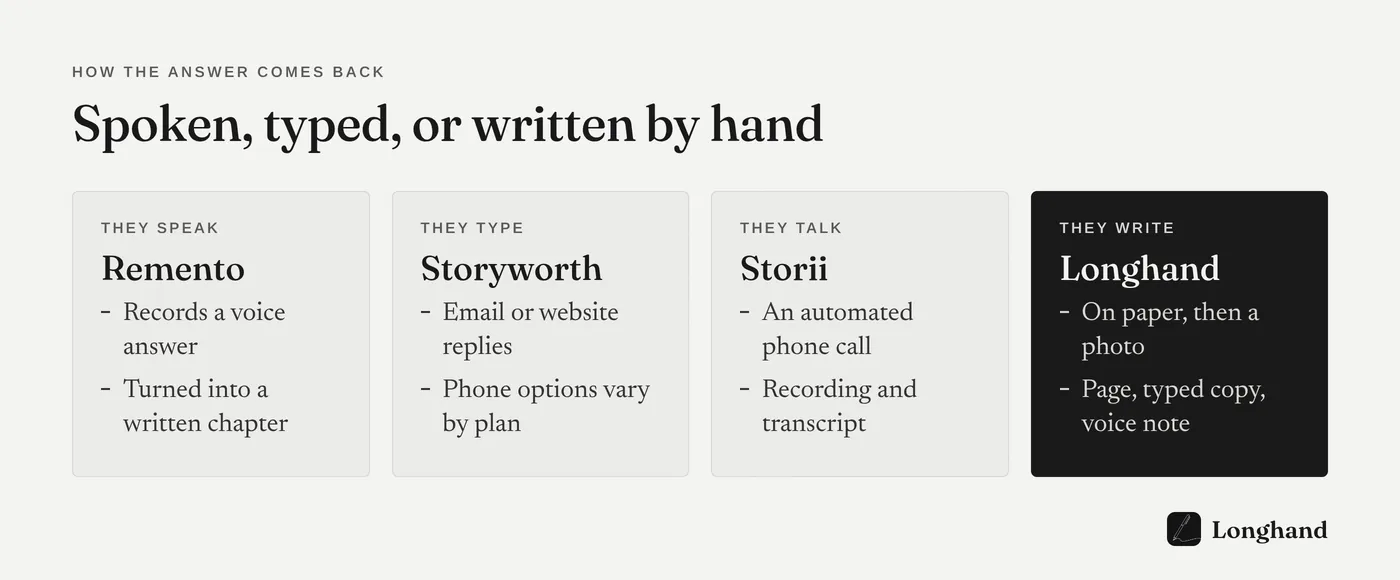
Remento: they talk, it writes
Remento sends a weekly prompt by email or text. Your parent taps the link and records their answer out loud. Remento says there's no app to download and no login. Its "Speech-to-Story" feature turns the recording into a written story. You can keep it as a word-for-word transcript or as a more polished narrative, and you can edit both. Each chapter in the finished book has a QR code that plays the original recording.
Storyworth: they write (or, on some plans, call)
Storyworth emails a question each week. You can change how often, up to once a day. Your parent replies by email or writes on the Storyworth website. They can also tell a story over the phone, landline included, and have it transcribed. Its plan page lists voice recording on every plan, while its FAQ says phone calls are for upgraded plans, so check what yours includes. At the end of the year the stories become a hardcover book.
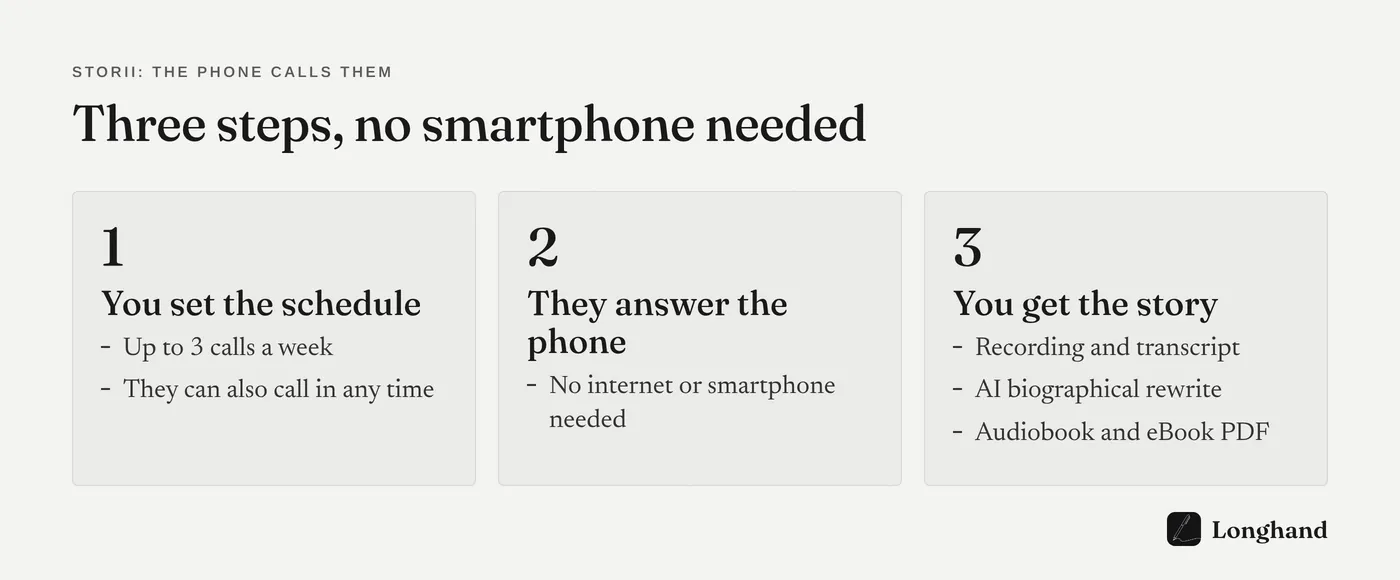
Storii: the phone calls them
Storii places automated phone calls, up to three a week on a schedule you set. Your parent can also call in any time. Storii says no internet or smartphone is needed. It records, transcribes and can produce an AI "biographical rewrite" of the answers. You can download the result as an audiobook and an eBook PDF. For a closer look at Storii on its own, see Storii vs Longhand: voice calls or handwritten pages?.
Longhand: they write by hand, you get the page
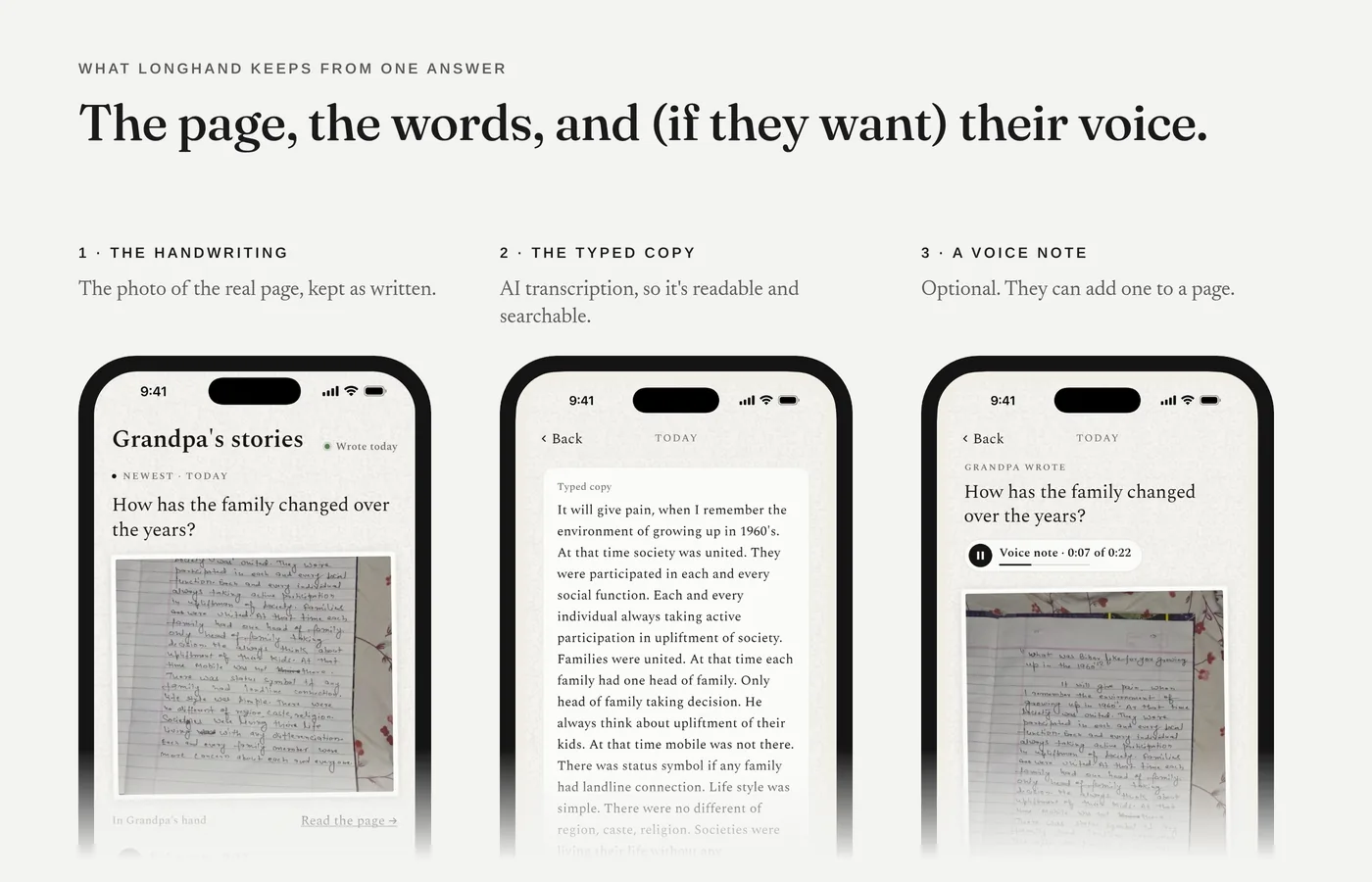
With Longhand, you pick the questions from prompt packs (Childhood, Love, Work, Hard Times, Wisdom) or take personalised suggestions. Your parent gets one question a day, answers on paper and takes a photo with the app. The app cleans up the page and uses AI to transcribe it, so the story is readable and searchable. You get their actual handwriting, the typed copy, and a voice note if they chose to add one. There are no streaks, so they can't fall behind.
How do Remento, Storyworth, Storii and Longhand compare?
| Remento | Storyworth | Storii | Longhand: Life Story Journal | |
|---|---|---|---|---|
| How your parent answers | Speaks (records a voice answer) | Types by email or website; can voice-record by phone (options vary by plan) | Talks on an automated phone call | Writes on paper, snaps a photo |
| What you keep | Recording + written chapter | Typed stories, plus transcripts of phoned-in stories | Recordings, transcripts, AI rewrite | Handwritten page + typed copy + optional voice note |
| Needs a smartphone? | Not necessarily: Remento says if they can answer a phone call or click an email link, they can use it | No: email or web, and phone options | No, a phone line is enough | Yes, the parent uses the app (iPhone, iPad or Android) |
| How often | Weekly prompts | Weekly by default, adjustable to daily | Up to 3 calls a week | One question a day, no streaks |
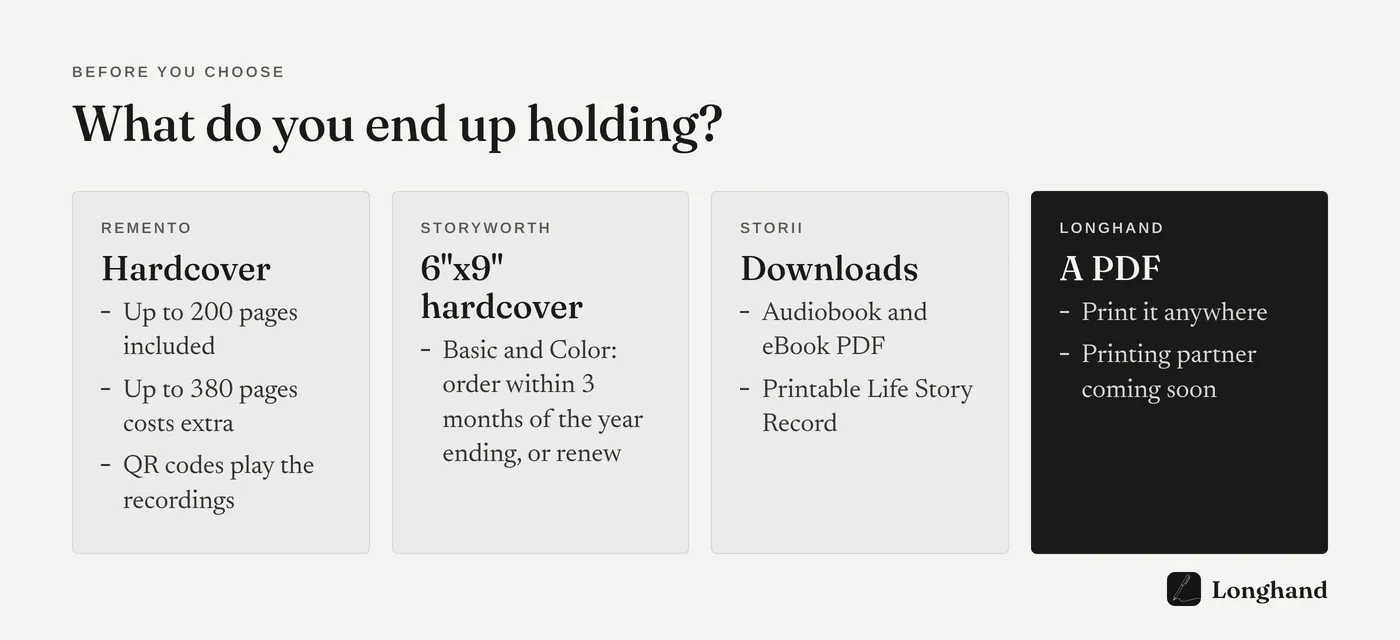
| Printed book | 8"x10" full-colour hardcover included, QR codes to recordings | 6"x9" hardcover included (black and white or colour by plan) | Downloadable audiobook and eBook PDF; "print a Life Story Record" | PDF export you can print anywhere; printing partner coming soon |
| Price model | One-off purchase covers a year and one book, then optional renewal | One-off plans (A$99, A$189, A$339 as shown in Australia), Unlimited renews yearly | Subscription (A$14.99/month or A$99.99/year as shown in Australia) | Free during early access; it will become a paid subscription later |
| Other languages | English and Spanish | English and Spanish | Not checked | 16 languages, including reading handwriting |
From each company's own website, read 3 November 2026. Prices showed in Australian dollars because I was browsing from Australia. Remento's homepage lists $99 for the first year and one book. Longhand is free only while it's in early access, so its row isn't a like-for-like price comparison yet. Check the current listing before you buy. Sources: Remento FAQ, Storyworth FAQ, Storii pricing.
A few details worth knowing before you choose:
- Remento's book length. The included book covers up to 200 pages. Its FAQ says longer books, up to 380 pages, cost extra. Extra copies are listed at $69 on its homepage, and from A$99 on the FAQ as I saw it from Australia. Each book is for one storyteller.
- Storyworth's deadline. On the Basic and Color plans you're asked to order your book within three months of the year ending, or renew. Family calls and guided phone interviews only come with the higher plans. Its 30-day refund applies only if no books have been printed.
- Storii's printed output. The pages I read describe audiobook and eBook PDF downloads plus a printable "Life Story Record". I didn't see a bound hardcover in the plans.
- Longhand's book. Longhand gives you a PDF of the stories that you can send to yourself and get printed anywhere you like. A printing partner is coming soon. Until then, Longhand doesn't print books itself.
Why does handwriting matter to some families?
Two reasons come up again and again.
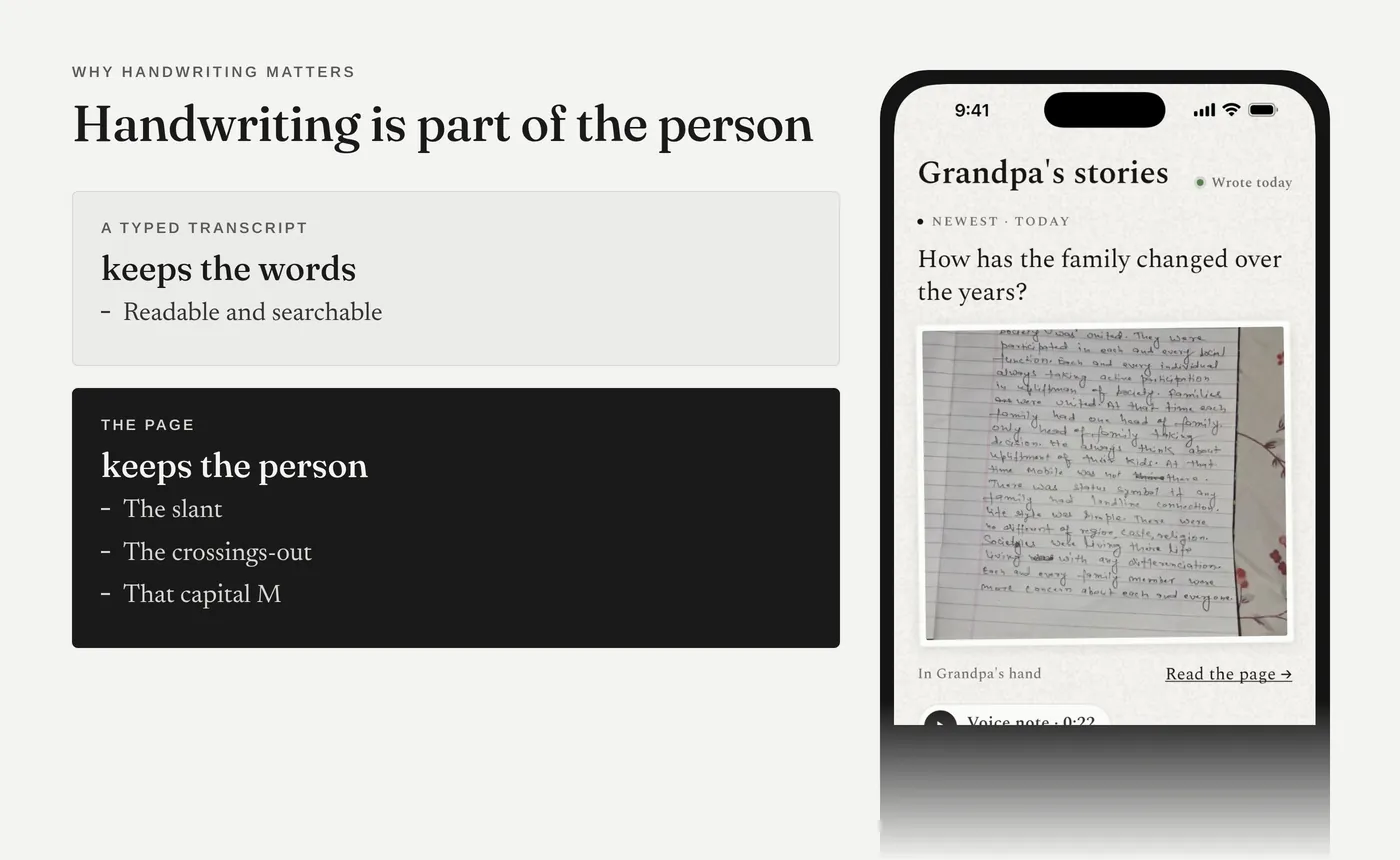
Handwriting is part of the person. Most of us have a birthday card or a recipe in a parent's writing that we'd never throw out. A typed transcript keeps the words. The page keeps the slant, the crossings-out and the way they always write a capital M. With voice apps you hear them; with Longhand you see their hand.
Some parents think better on paper. Plenty of people freeze when they're recorded, and plenty more won't type more than a sentence on a phone. Give the same person a pen, a quiet ten minutes and one question, and you might get a full page. It's also why I built Longhand. I live in Australia and my dad lives in India. He's never been one to type out a story, but he'll fill a page by hand without thinking twice, and a daily question changed our calls.
None of that makes voice worse. A recording keeps their laugh and their accent, and that's precious too. If you want both, Longhand lets them add a voice note to a page. But if hearing them is the main thing you want, Remento and Storii are built around voice in a way Longhand isn't.
Which one should you choose for your parent?
- Choose Remento if your parent is a talker, you want their recorded voice in the finished book, and you'd like a printed hardcover included.
- Choose Storyworth if your parent is comfortable writing emails, you want the best-known option, and a hardcover book at the end of the year is the goal.
- Choose Storii if your parent doesn't use a smartphone or the internet but will happily chat on the phone.
- Choose Longhand: Life Story Journal if your parent likes writing by hand, you want their actual handwriting kept alongside the typed words, and you'd like a small daily habit rather than a weekly project.
When Longhand is the wrong pick. Don't choose it if writing by hand is hard for your parent (arthritis, a tremor, poor eyesight), if they won't use a phone or tablet camera at all, or if you need a bound book in your hands now. For now you'd be printing the PDF yourself, until our printing partner arrives.
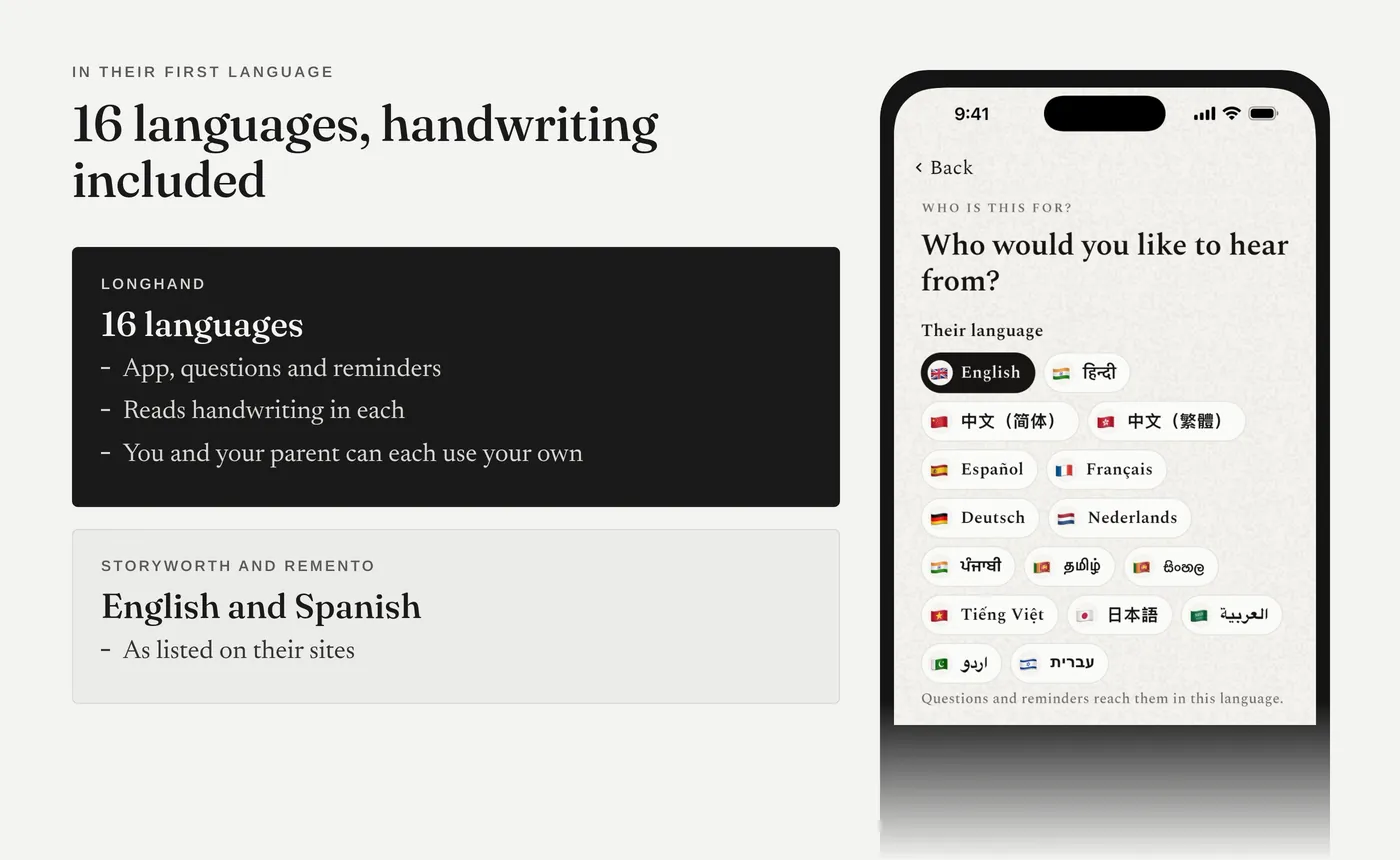
If your parent would rather write in their first language, Longhand may suit them better than you'd expect. The app, its questions and its reminders come in 16 languages, from Hindi and Tamil to Spanish and Arabic, and it reads handwriting in each of them. You and your parent can each use your own. Storyworth and Remento both list English and Spanish.
If it does sound right, Longhand is free right now during early access, while I learn from the first families using it. It will become a paid subscription. When it does, one subscription per parent will cover both of you, and your archive will stay viewable and exportable if you stop paying. There are no ads, and we never sell your data.
Start Longhand: Life Story Journal free during early access.
Pick a question tonight. They answer on paper whenever suits them, and you get the page.


Disclosure: I make Longhand: Life Story Journal. Remento, Storyworth and Storii are other companies' products, and they haven't reviewed this page. Spotted something out of date? Email development@digitalsauce.io and I'll fix it.
What else do people ask?
Is Remento better than Storyworth?
It depends on how your parent likes to tell stories. Remento suits talkers: they record their answers out loud, and the book links back to those recordings with QR codes. Storyworth suits people who are happy writing by email or on its website, with phone recording options that vary by plan. Both include a hardcover book. Check each one's current plans before you buy.
Do any of these keep handwriting?
Of the four, only Longhand: Life Story Journal is built around handwriting. Your parent writes on paper and takes a photo, and you keep the page itself alongside a typed copy. Remento and Storii are built around voice, and Storyworth around typed or phoned-in answers. None of their pages that I read describe handwriting transcription.
Can I get a printed book?
Yes, with Remento and Storyworth, which both include a hardcover in their plans. Storii offers downloadable audiobook and eBook PDF files. Longhand gives you a PDF you can share with yourself and print anywhere, and a printing partner is coming soon.
What if my parent isn't techy?
Storii needs only a phone line, and Storyworth can work by email or, on some plans, by phone. Remento says that if your parent can answer a phone call or click an email link, they can use it. Longhand needs your parent to take a photo in the app, but the rest happens on paper. It uses large type, and there are no streaks to keep up with.