Quick answer
Pick Storii if your parent would rather talk: it phones them up to three times a week with a life story question, records the answer and transcribes it, and needs no internet or smartphone. Pick Longhand: Life Story Journal if they'd rather write: they answer one question a day on paper, take a photo, and you keep the page in their own handwriting with a typed copy.
I'm Sanket, and I make Longhand, so I'm not neutral here. I've tried to be fair to Storii, which does something Longhand doesn't: it keeps your parent's spoken voice without asking them to touch an app. Everything about Storii below comes from its own website as I read it on 4 November 2026. Plans change, so check the current listing before you buy.
How does Storii work?
Storii is built around the phone. You set up an account, add your parent's phone number, and choose the days and times for calls, up to three a week.
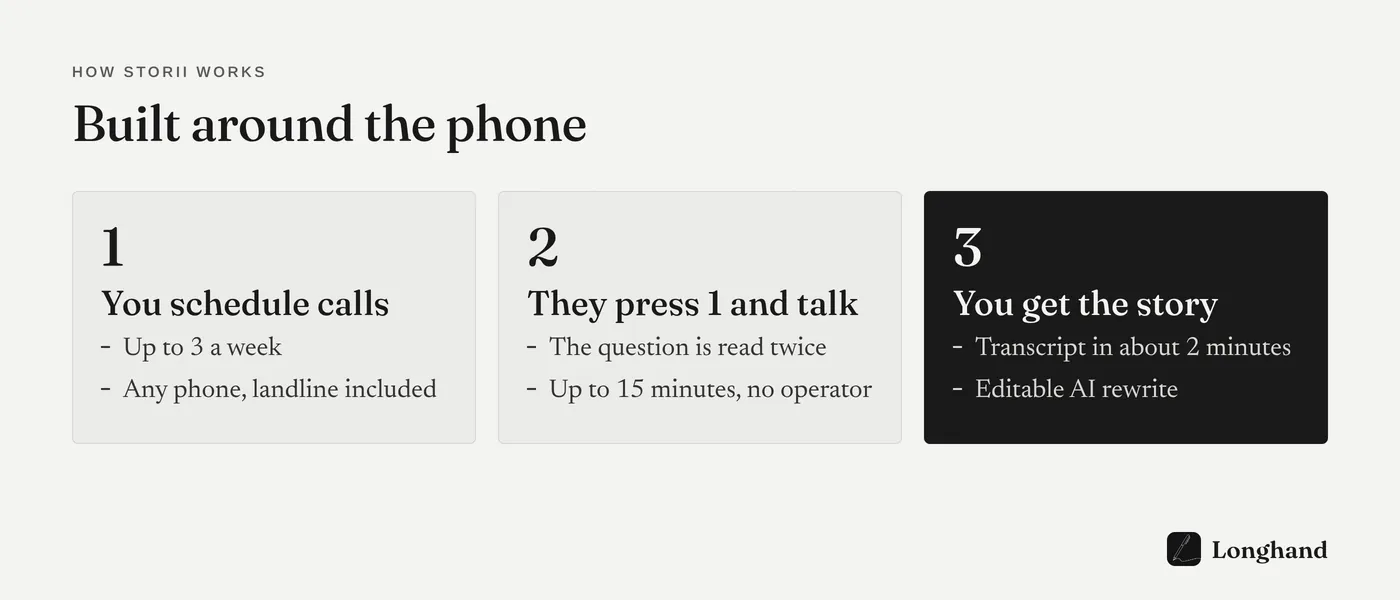
- The call: a chime, then an automated voice reads the question twice. Your parent presses 1 and talks, for up to 15 minutes. There's no operator on the line.
- Missed calls: they can call the same number back any time to hear the next question and record their answer.
- Questions: a library of more than 1,000 life story prompts, or your own (up to 120 words). You can reorder the queue.
- What you get: the recording, a transcript within about two minutes, and an "AI Biographical Rewrite" you can edit. Family get a text when a new story is recorded, and can add photos, video or more audio. Recordings download as an audiobook, and the transcripts as an eBook PDF you can print.
- Phones: any phone with a number, landline included. Storii says no internet or smartphone is needed. Family members use the website or the Storii Family app.
- Languages and countries: calls in American, British and Australian English, French, Spanish, Japanese and Italian, to 17 countries including the US, Canada, the UK, Australia and New Zealand.
- One number per account. For two parents, Storii suggests separate subscriptions.
If you stop paying, Storii says the stories stay on the profile in read-only form and you can export them.
How does Longhand work?
Longhand is built around a pen and paper. You choose the questions from prompt packs (Childhood, Love, Work, Hard Times, Wisdom) or take personalised suggestions.
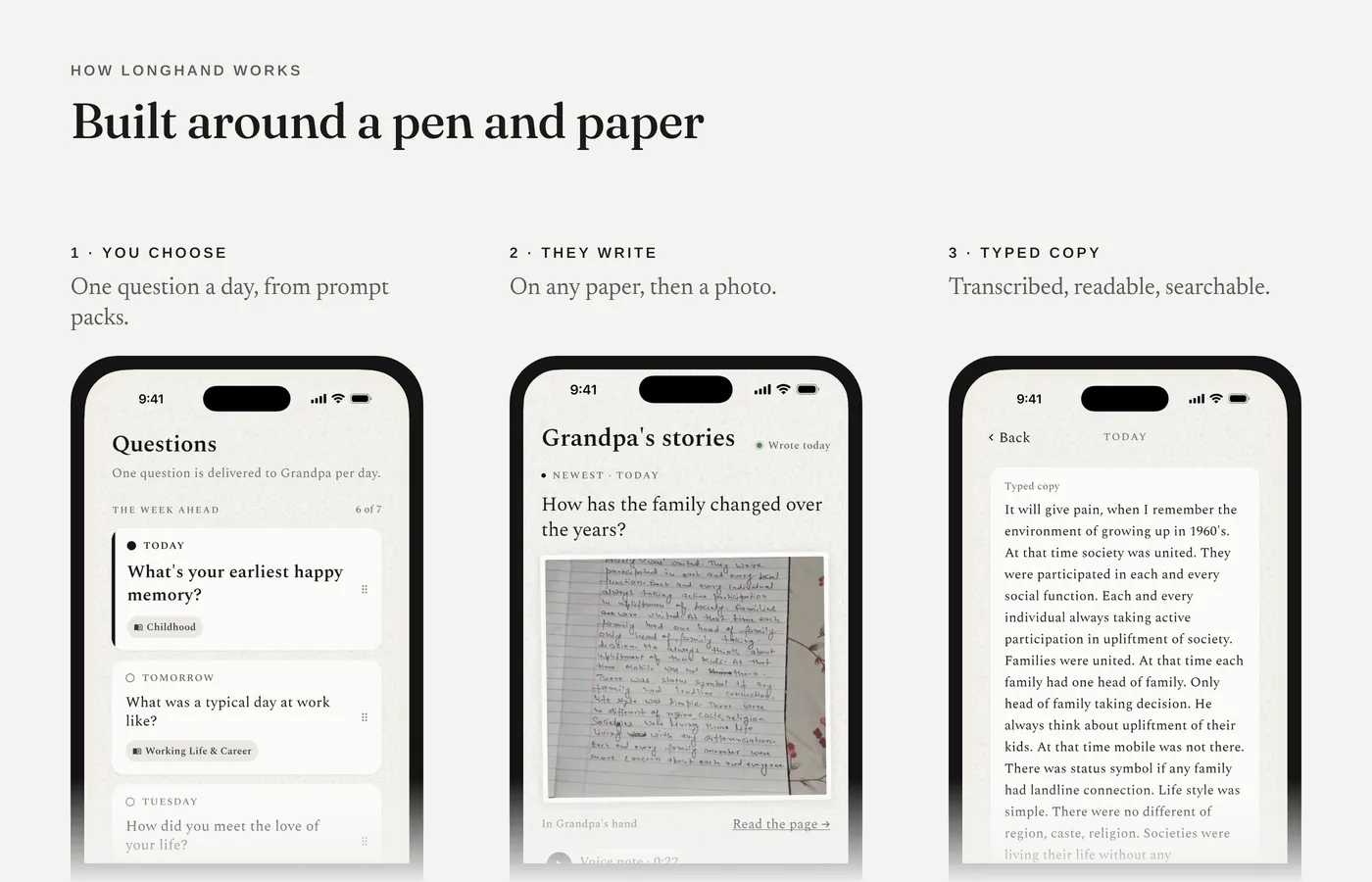
- One question a day. Your parent sees today's question in the app on an iPhone, iPad or Android device, in large type.
- They answer by hand, on any paper, then take a photo. The app cleans up the page and uses AI to transcribe it, so the story is readable and searchable.
- You get three things: the photographed page in their handwriting, the typed copy, and a voice note if they chose to add one. Stories gather into chapters.
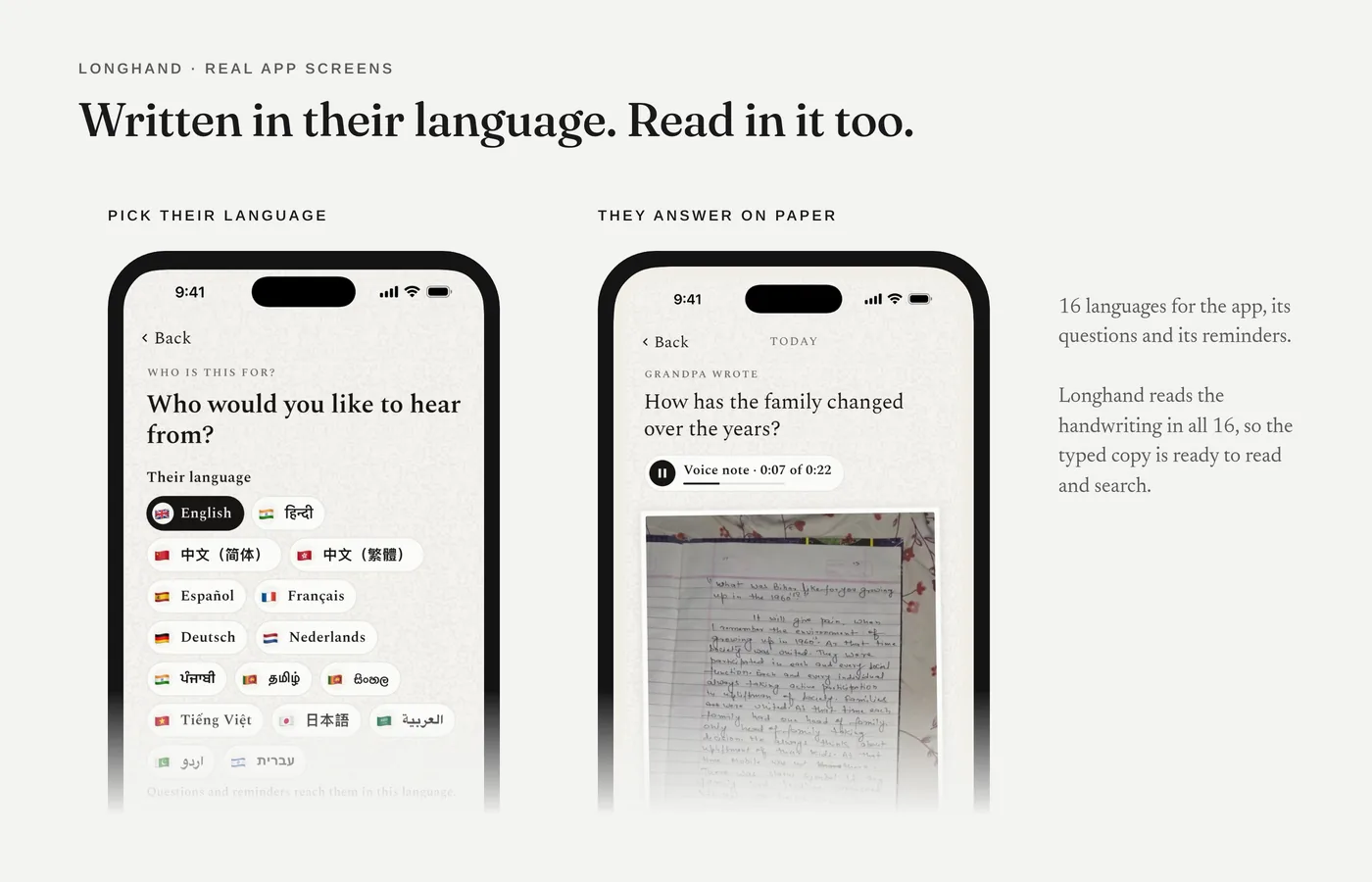
- 16 languages. The app, its questions and its reminders come in English, Hindi, Chinese (Simplified and Traditional), Spanish, French, German, Dutch, Punjabi, Tamil, Sinhala, Vietnamese, Japanese, Arabic, Urdu and Hebrew, and Longhand reads handwriting in all 16. You and your parent can each use your own language.
- No streaks. They can't fall behind, and nothing is locked behind a year-end deadline.
- Keeping it: your archive stays viewable and exportable. You can download a PDF and print it anywhere. A printed, bound keepsake service is coming soon, but Longhand doesn't print books today.
How do Storii and Longhand compare?
| Storii | Longhand: Life Story Journal | |
|---|---|---|
| How your parent answers | Talks on an automated phone call (press 1, up to 15 minutes) | Writes on paper, takes a photo in the app |
| What the family gets | Recording, transcript, editable AI rewrite; audiobook and eBook PDF downloads | The handwritten page, a typed copy, an optional voice note; PDF to print anywhere |
| Does your parent need a smartphone? | No, any phone line works | Yes: iPhone, iPad or Android |
| How often | Up to 3 scheduled calls a week, plus call-ins | One question a day, no streaks |
| Languages | Calls in 7 language options (3 of them English) | 16 languages, handwriting read in all of them |
| Cost (as of Nov 2026) | Subscription: $9.99 a month or $99 a year on Storii's US blog; A$14.99 a month or A$99.99 a year on its pricing page from Australia. Gift Box with 12 months: $59.99 USD on sale (from $119.99), US/UK only | Free during early access; it will become a paid subscription later |
| If you stop | Stories stay read-only and exportable | Archive stays viewable and exportable |
From Storii's own pricing page, FAQ, Gift Box listing and blog, and Longhand's site and App Store listing, read 4 November 2026. Storii's pricing page shows local prices, so I saw Australian dollars from Melbourne. Longhand is free only while it's in early access, so this isn't a like-for-like price comparison yet. Sources: Storii pricing, Storii FAQ, Storii Gift Box, Storii blog: plan prices.
What do you actually end up keeping?
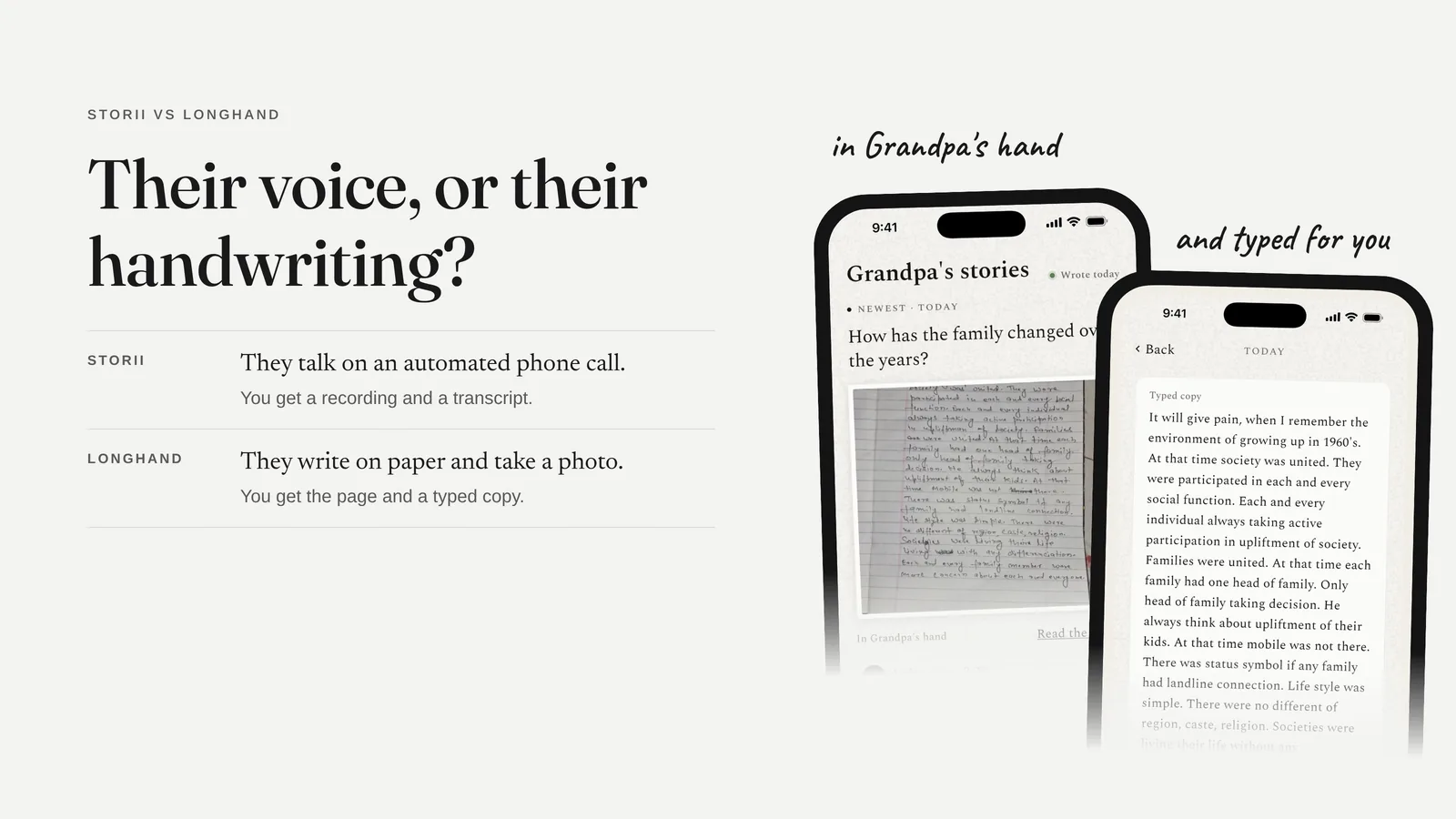
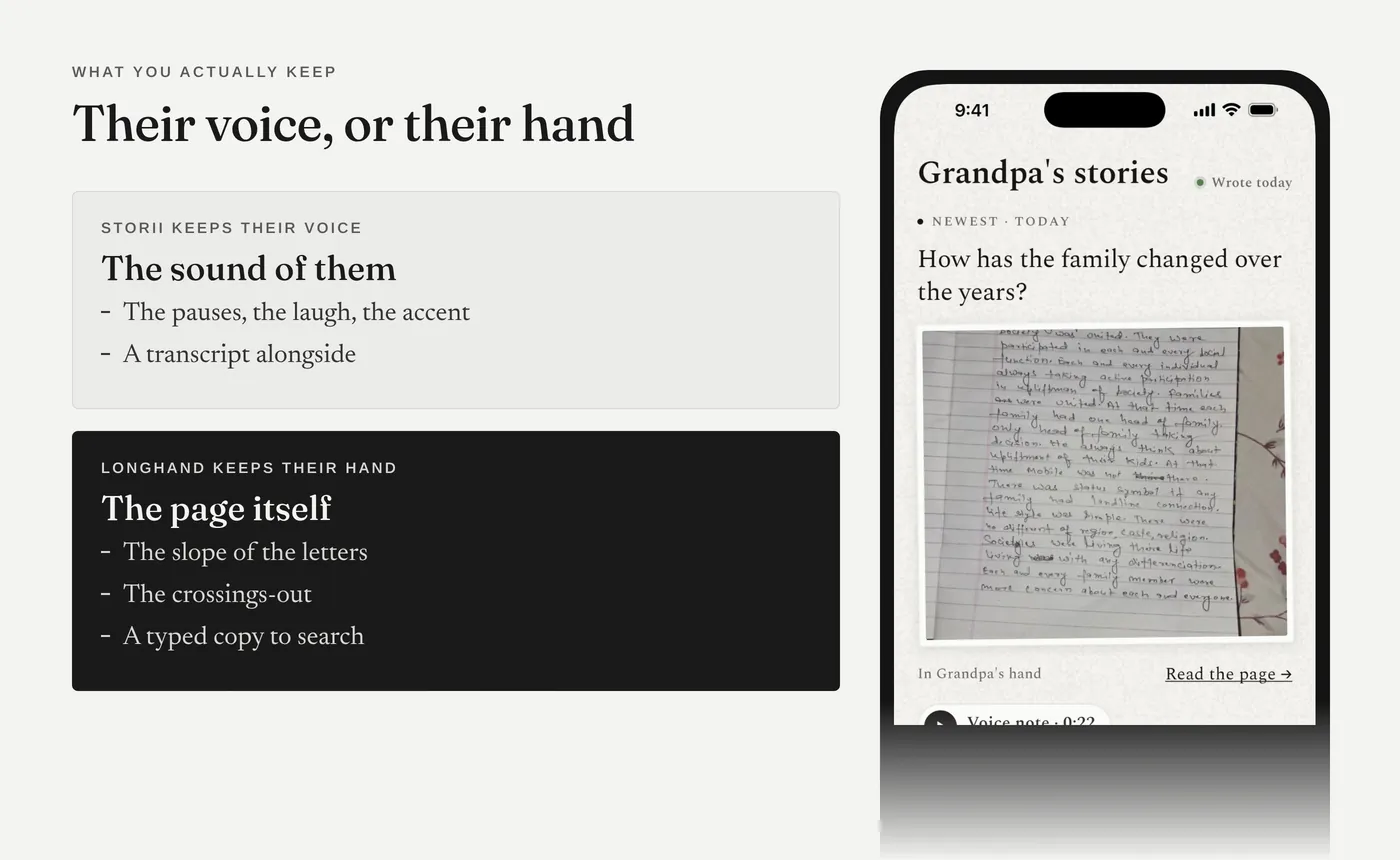
This is the real difference. With Storii you keep their voice: the pauses, the laugh, the accent, and a transcript to read alongside it. With Longhand you keep their hand: the slope of the letters, the crossings-out, the page itself, with a typed copy so the rest of the family can read and search it.
Neither is better in general. If hearing them is what you want most, Storii is built for that in a way Longhand isn't. Longhand's voice note is optional, and it sits alongside the page rather than replacing it. If you want the thing you'd frame or tuck into a book, that's the handwritten page.
Who should pick Storii, and who should pick Longhand?
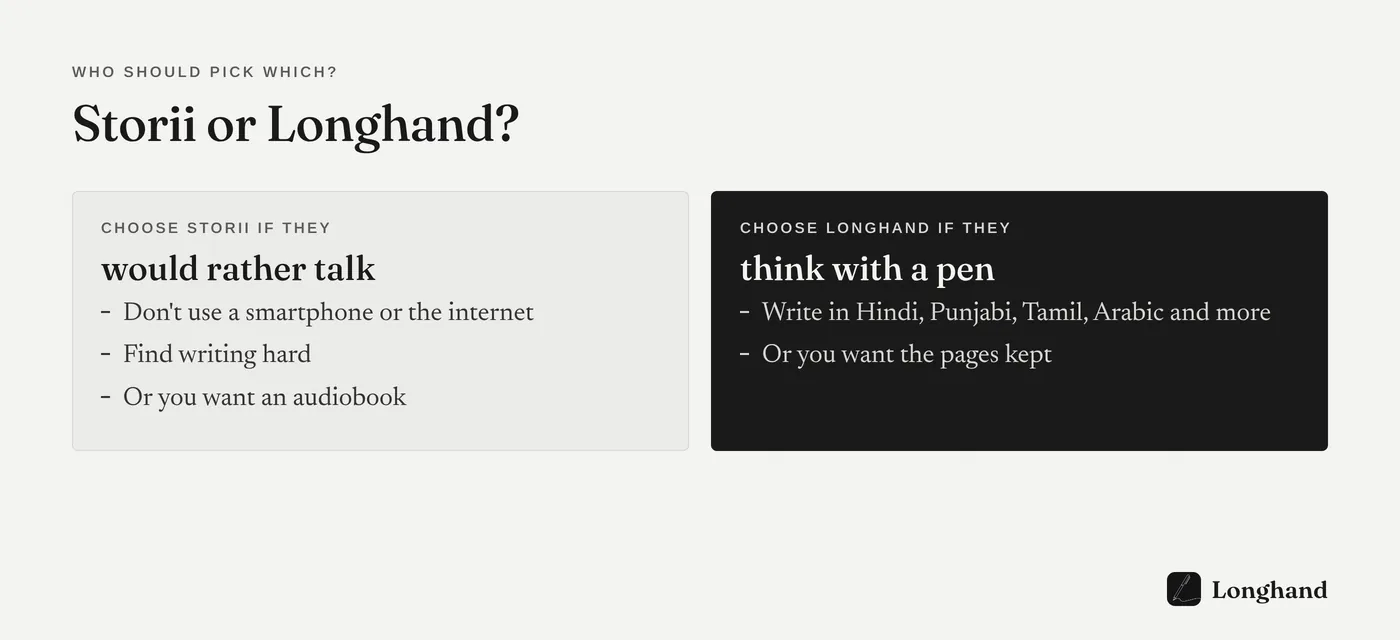
- Choose Storii if your parent is a talker, doesn't use a smartphone or the internet, or finds writing hard (arthritis, a tremor, poor eyesight). Also if you want an audiobook of their voice.
- Choose Longhand if your parent thinks better with a pen, if they'd rather write in a language Storii's calls don't offer, such as Hindi, Punjabi, Tamil or Arabic, or if you want the actual handwritten pages kept.
- When Longhand isn't the one: if your parent won't use a phone or tablet camera at all, or if you need a bound book in your hands soon. For now you'd be printing Longhand's PDF yourself.
I built Longhand for my dad in India, who talks with me every day and was its first writer. If you're comparing more options, I've also put Remento, Storyworth, Storii and Longhand side by side and rounded up six Storyworth alternatives.
Start with one question today.
Longhand: Life Story Journal is free during early access. Pick a question tonight; they answer on paper, in their own language.


Disclosure: I make Longhand: Life Story Journal. Storii is another company's product, and Storii hasn't reviewed this page. Spotted something out of date? Email development@digitalsauce.io and I'll fix it.
What else do people ask?
How much does Storii cost?
Storii is a subscription. Its US blog lists $9.99 a month or $99 a year, and its pricing page showed A$14.99 a month or A$99.99 a year when I checked from Australia. A Gift Box with 12 months of calls was on sale for $59.99 USD, down from $119.99, for the US and UK only (as of Nov 2026).
Does my parent need a smartphone for Storii?
No. Storii calls any phone number, landline included, and your parent presses 1 and talks. Family members listen and read the transcripts on Storii's website or in the Storii Family app.
Can Longhand keep my parent's actual handwriting?
Yes, that's the point of it. Your parent writes on paper and takes a photo in the app, and you keep the photographed page with a typed copy and an optional voice note. Your archive stays viewable and exportable.
Is Longhand available in other languages?
Yes. The app, its questions and its reminders come in 16 languages: English, Hindi, Chinese (Simplified and Traditional), Spanish, French, German, Dutch, Punjabi, Tamil, Sinhala, Vietnamese, Japanese, Arabic, Urdu and Hebrew. Longhand reads handwriting in all 16.
Storii vs Storyworth: what's the difference?
Storii phones your parent and records them talking. Storyworth sends a weekly question by email or text. On every plan your parent can reply in writing, by email or on its website; upgraded plans add telling stories over the phone, which Storyworth transcribes. At the end, the stories and photos become a hardcover book. As of Nov 2026, Storyworth's homepage lists plans starting at $59 (US), with one hardcover book included; check storyworth.com for current plans and prices. There's a fuller side-by-side, with Remento too, in our Remento vs Storyworth comparison.