TL;DR
To make a family history book, collect your family's stories, photos and handwriting, digitise them, sort them into chapters by person, era or theme, lay them out as one PDF, and print a single proof copy before ordering more. A small book of 20 to 40 stories is a realistic first goal, and you can print it at home, at a local shop or through a print-on-demand service.
I'm Sanket, and I make Longhand, an app that collects a parent's or grandparent's stories as handwritten pages. So I'll be upfront: I think handwriting belongs in a family history book, and this guide leans that way. Everything below works with paper, a phone camera and free software, whether or not you use Longhand.
How do you make a family history book?
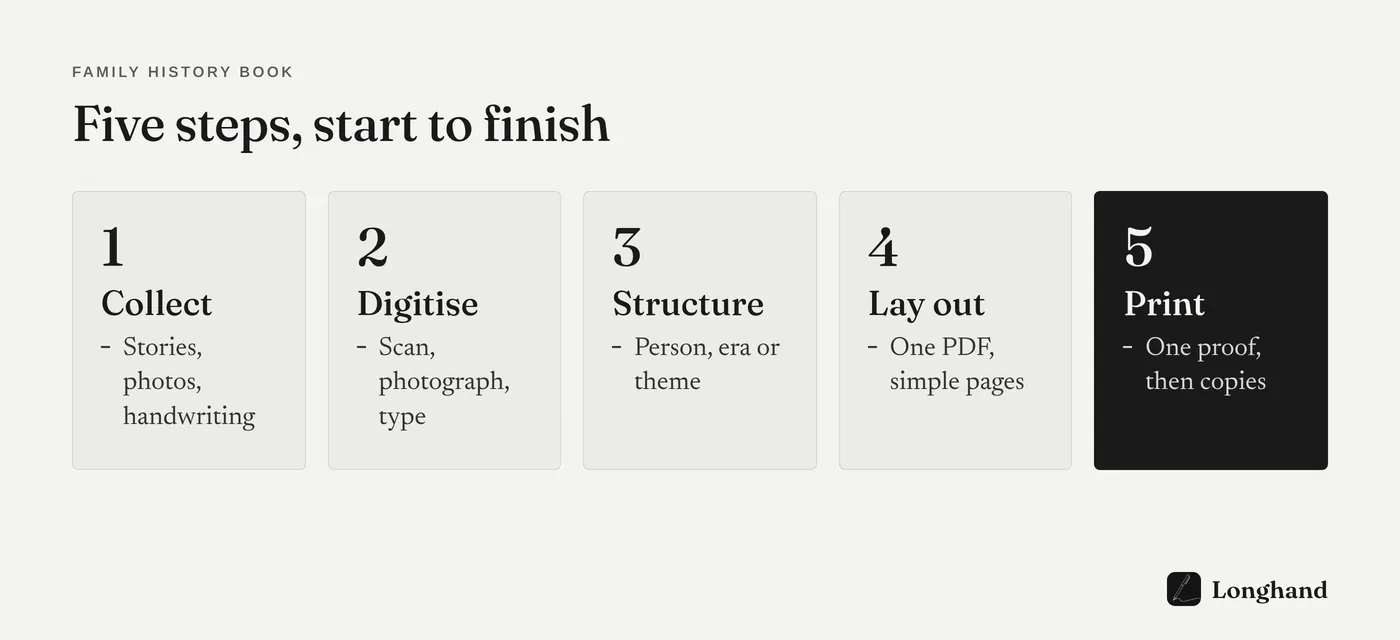
You work in five steps. Most families get stuck at the first one, because "our family history" feels too big. So set a small target: one book, one family line, 20 to 40 stories. You can always make volume two.
- Collect stories, photos and handwriting.
- Digitise everything: scan photos, photograph handwritten pages, type the words.
- Structure the book into chapters by person, era or theme.
- Lay it out as a single PDF with a simple, consistent page design.
- Print one proof copy, fix what's wrong, then order copies for the family.
What should you collect for a family history book?
Start three piles: stories, photos and handwriting. Stories are the heart of it. Photos make people want to open it. Handwriting is what they'll treasure in 50 years, and it's the pile families most often forget.
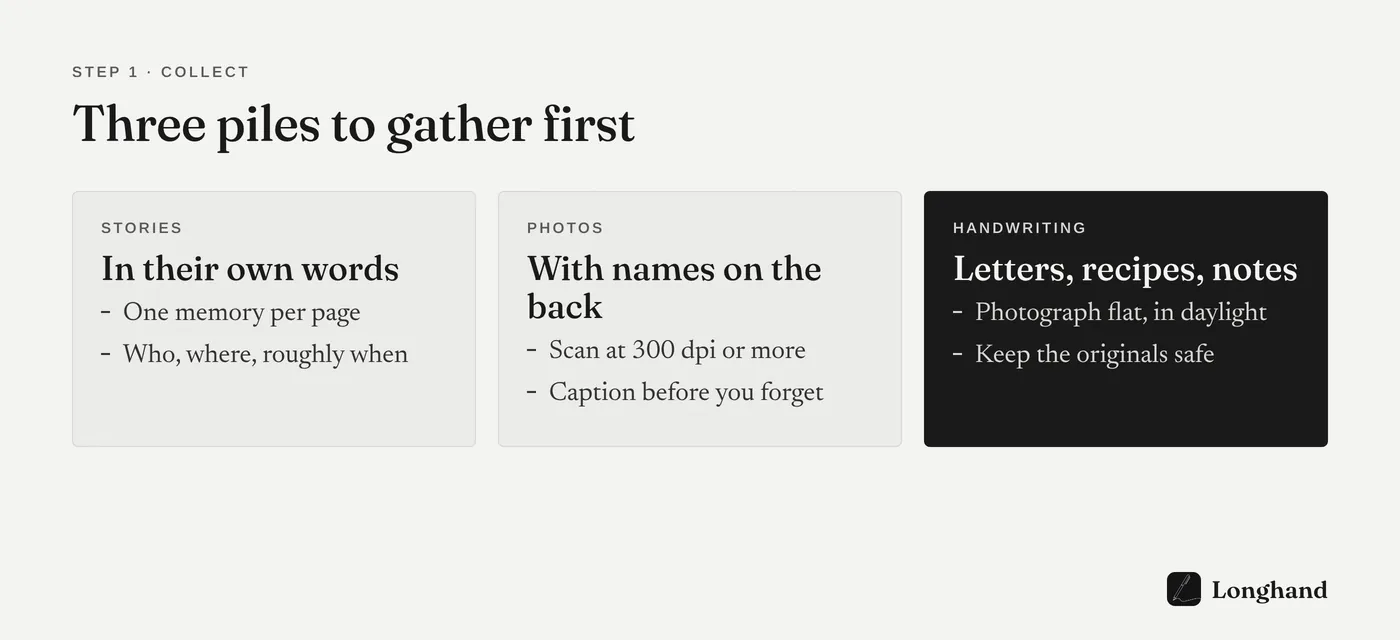
- Stories. Ask one question at a time ("Where did you live when you were ten?") rather than "tell me about your life". Get one memory per page, with who, where and roughly when. If you need questions, start with these life story interview questions or questions to ask your grandparents.
- Photos. Scan prints at 300 dpi or more, and write names and dates down while someone still remembers them.
- Handwriting. Letters, recipe cards, the inside of a birthday card, or a page written specifically for the book. Photograph each page flat, in daylight, and keep the originals somewhere safe.
Why include handwriting in a family history book?
Because a typed story tells you what happened, and a handwritten page tells you who was there. The slant, the crossings-out, the way your grandmother wrote her "7" are part of the record. They can't be recreated once the person is gone.
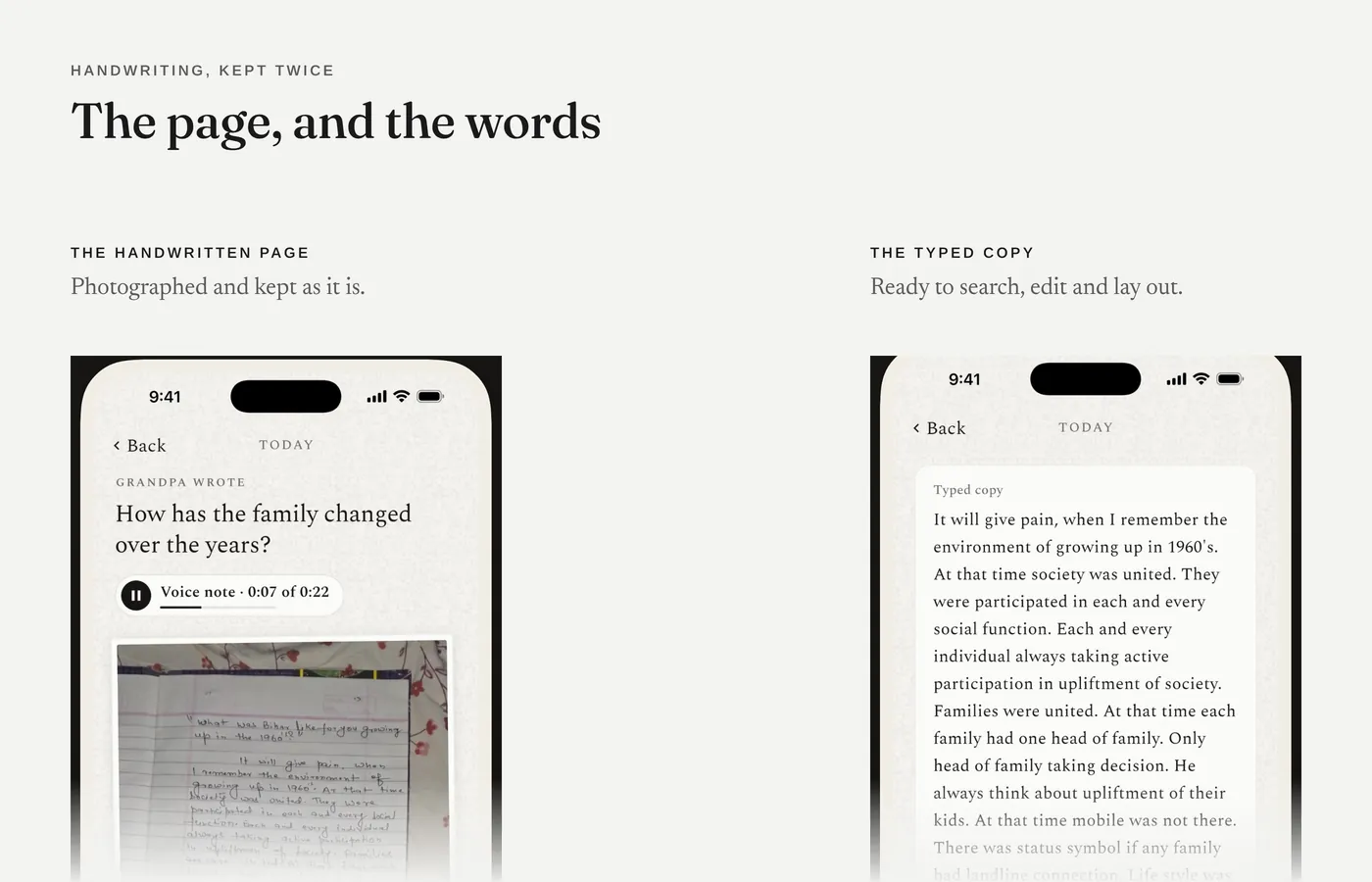
The practical trick is to keep every story twice: the photographed page as an image, and a typed copy of the words. The image goes in the book; the typed copy makes the book searchable, easy to edit, and readable for grandchildren who struggle with cursive. In Longhand, that happens automatically: your parent writes on paper, takes a photo, and the app keeps the page and makes the typed copy.
How should you structure the chapters?
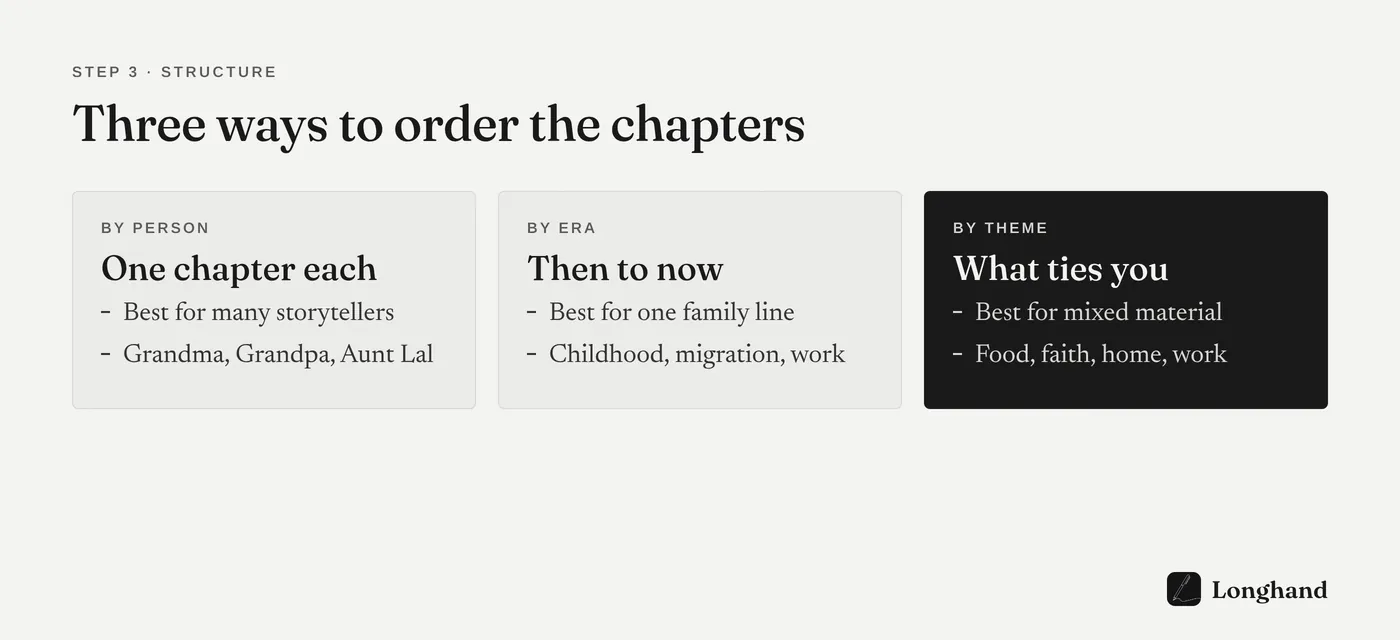
Pick one structure for the whole book. The three that work best:
- By person: one chapter per storyteller. Best when several relatives are contributing.
- By era: childhood, moving away, work, family, later years. Best for one family line.
- By theme: food, faith, home, work. Best when the material is mixed and patchy.
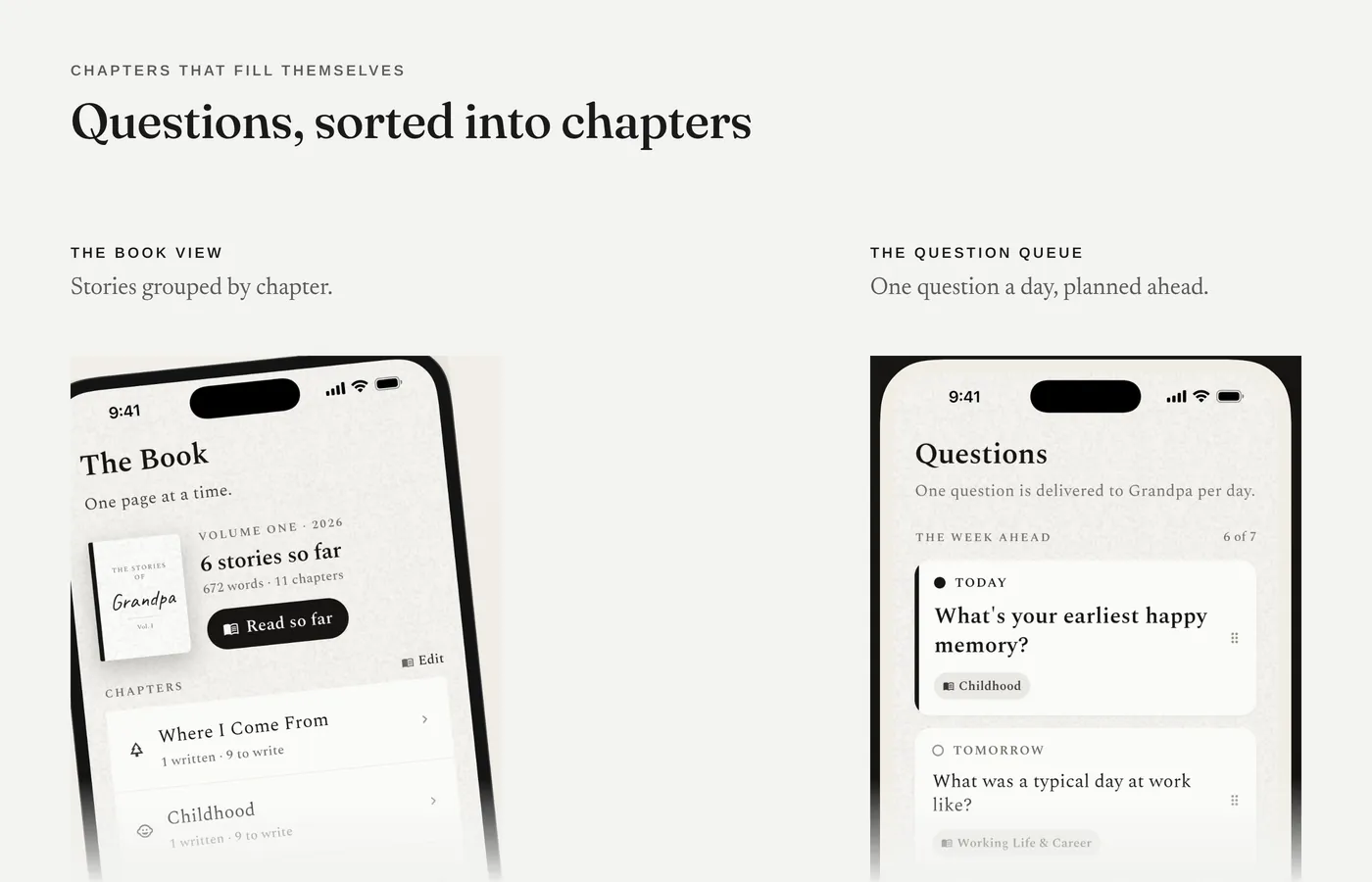
Inside each chapter, open with the strongest story, not the earliest. Add a short introduction (two or three sentences) saying who's speaking and when. And leave gaps visible: a chapter with two stories is a prompt to go back and ask for more, not a failure.
How do you lay out a family history book for free?
You don't need design software. A word processor you already have will do: Google Docs (free) or Pages (free on Apple devices). Set the page size to match the book you'll print (for example 6 × 9 inches), use one serif font for the stories, and put each handwritten page as a full-width image next to its typed copy. Export everything as one PDF.
Some simple rules that keep it readable:
- One story per spread where you can: the handwritten page on the left, the typed words on the right.
- Captions under every photo: names left to right, place, year.
- A family tree at the front and a list of contributors at the back, so readers know who's who.
How many pages will you need? Use the planner below to get a rough page count and print estimate.
How much does it cost to print a family history book?
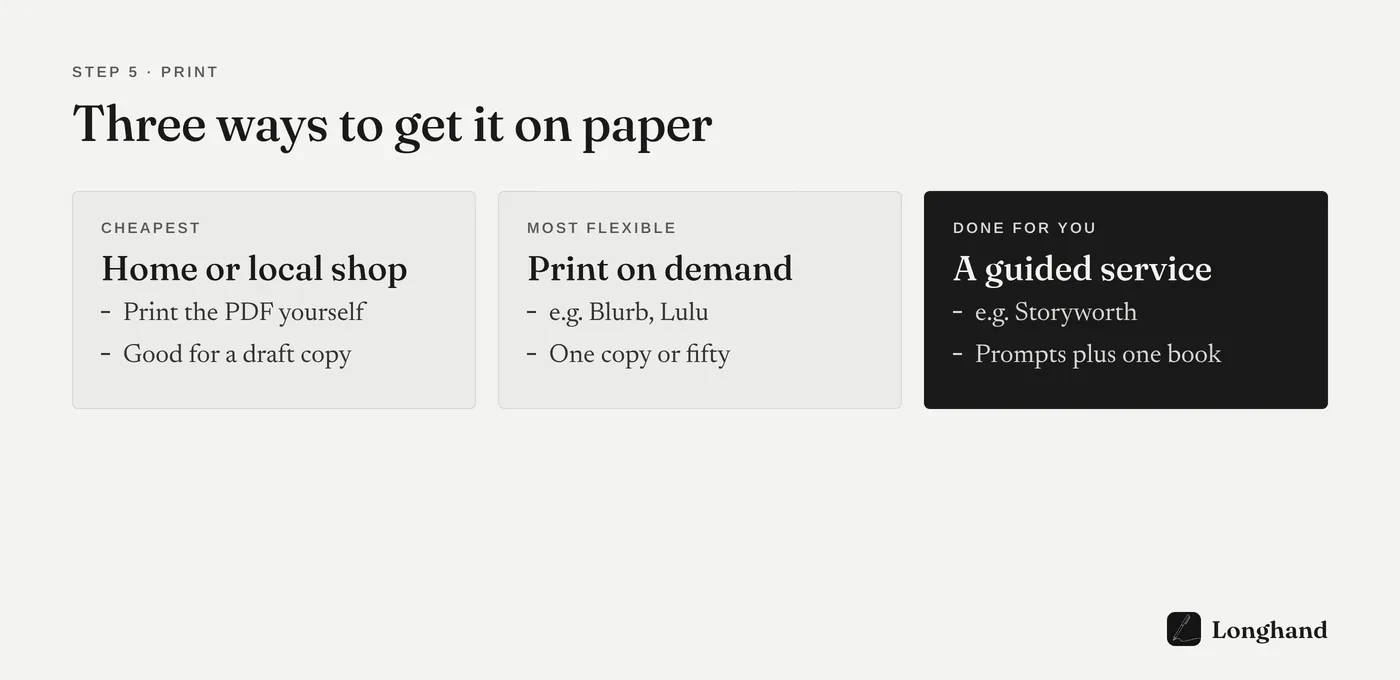
It depends on size, page count, paper and binding. As of 5 November 2026, a print-on-demand paperback can start under US$10, while a guided service that also sends the questions costs more. Here's what I found on each site:
| Option | Price (as of 5 Nov 2026) | Best for | Watch out for |
|---|---|---|---|
| Print the PDF at home or a local print shop | Paper and ink, or a shop quote | A first proof or a few draft copies | Binding options and quality vary by shop |
| Blurb, paperback and hardcover books | From US$8.99 (paperback); 6 × 9 imagewrap hardcover from US$14.99 (economy colour) or US$18.99 (black and white) | Text-heavy books with some photos and scanned pages | Extra pages add US$0.04 to US$0.17 each; shipping extra |
| Blurb, photo books | From US$12.00; 8 × 10 hardcover from US$38.00 | Photo-heavy books | Costs rise quickly with premium paper and layflat |
| Lulu | 6 × 9 paperback (standard black and white, 60# paper) starting at US$4.11 | Comparing print-on-demand quotes, text-heavy books | Colour, hardcover and more pages cost more; use its calculator |
| Storyworth | From US$69 (US site), as of November 2026 | A year of weekly questions by text or email, plus one hardcover | You're buying a service, not just printing |
Sources, read 5 November 2026: Blurb pricing (US prices, before shipping and tax), Blurb page limits (24-page minimum for paperback and hardcover books), Lulu print books and its pricing calculator, and Storyworth. Prices change; check each site and your country's shipping before you order. Blurb offers volume discounts from 10 copies.
My advice: always order one proof copy first. Mistakes that are invisible on a screen (a photo too dark, a caption on the wrong page) are obvious in print. Fix them, then order for the whole family.
Where does Longhand fit?
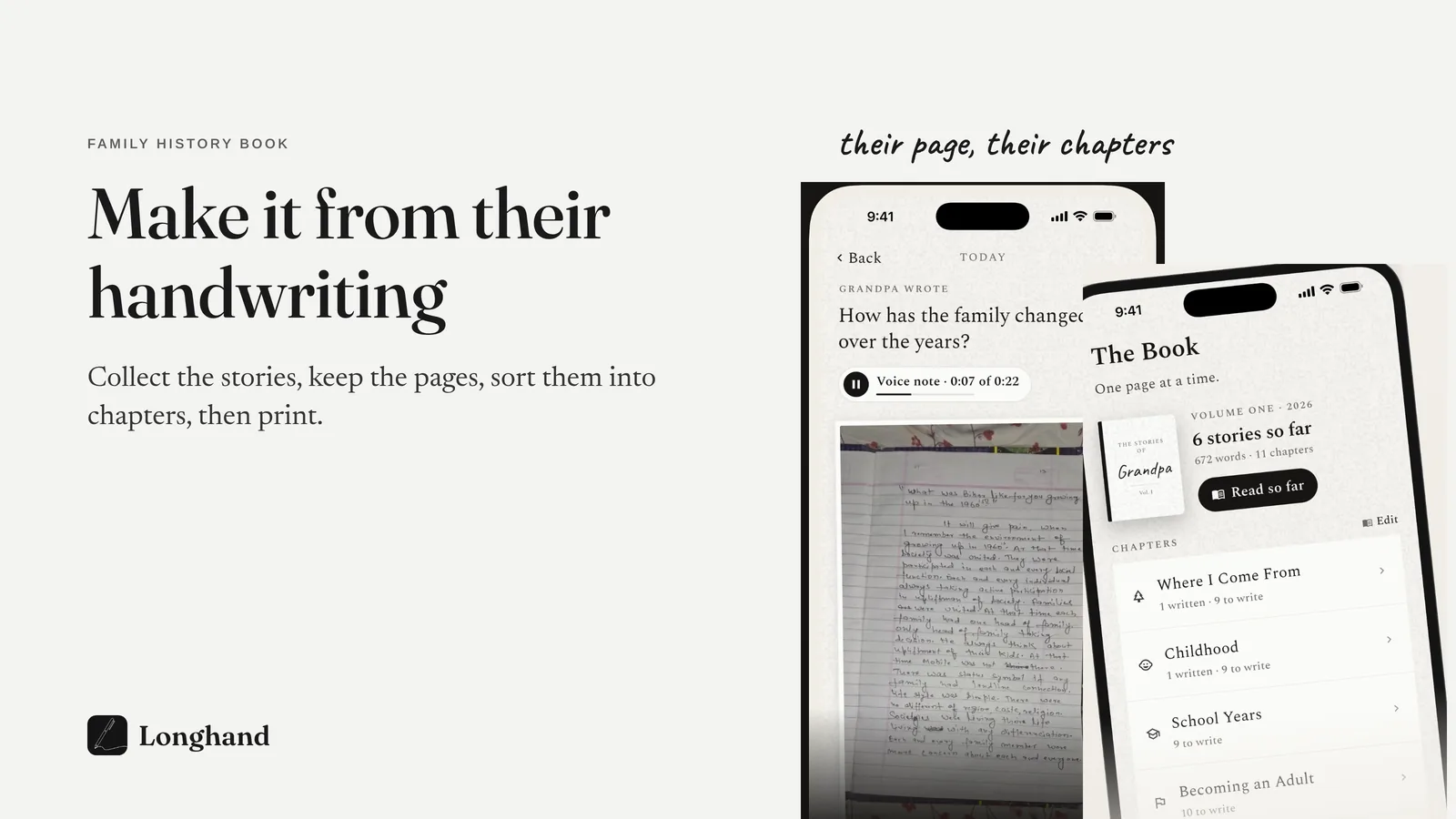
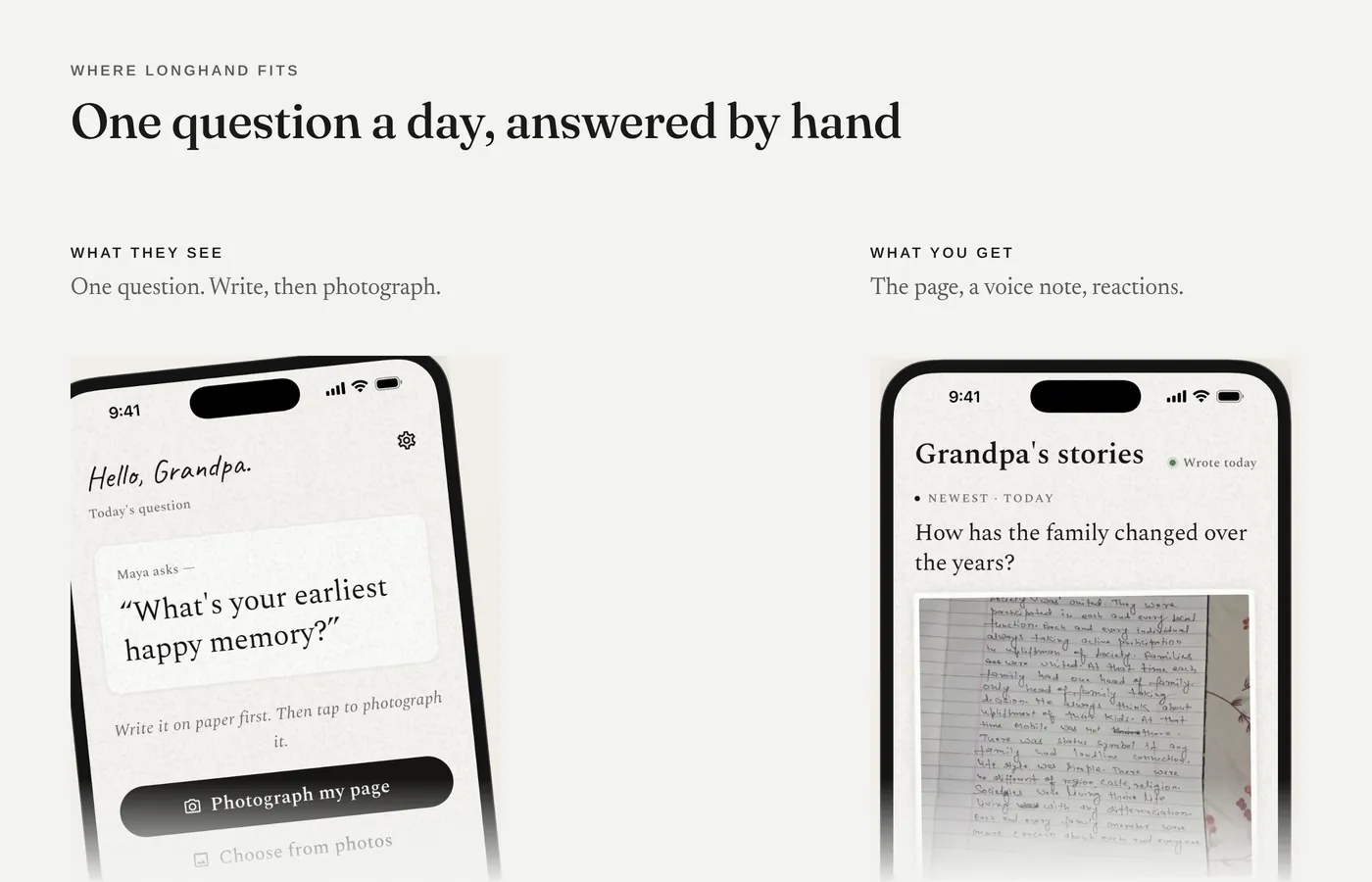
Longhand: Life Story Journal handles the collecting and digitising steps, which are the slow ones. It doesn't print books: it gives you an exportable PDF to print with any of the options above, or at home. You choose questions for a parent or grandparent. They get one question a day, write the answer on any paper and take a photo. You get the handwritten page, a typed copy and an optional voice note, and the stories are grouped into chapters as they come in.
It works in 16 languages and reads handwriting in all 16, so a grandparent can write in Hindi, Tamil, Vietnamese or Arabic and the family still gets a typed copy. It's on iPhone, iPad and Android, and it's free while it's in early access (it'll become a paid subscription later). It exports a PDF of the stories that you can print anywhere: Blurb, Lulu, a local print shop or your own printer. Longhand doesn't print or bind books itself.
It's not a fit if the family history you're after is mostly records and dates (births, marriages, migration papers). For that, a genealogy service and archives are the right tools, and our guide on how to preserve family history covers the basics. If your grandparent would rather talk than write, see how to record your parents' life story or the Storyworth review.
Collect a parent's stories by hand with Longhand
Free during early access. Send one question today; they answer on paper, in their own language, and you keep the page and a typed copy.


Disclosure: I make Longhand: Life Story Journal. I haven't been paid by any print service mentioned here. Spotted a price that's changed? Email development@digitalsauce.io and I'll fix it.
What else do people ask?
How much does it cost to print a family history book?
As of November 2026, Blurb's paperback and hardcover books start at US$8.99, with 6 by 9 inch hardcovers from about US$15 to US$19 before extra pages and shipping. Printing a PDF at home or a local shop is cheaper for a draft. Lulu's 6 by 9 inch black and white paperback starts at US$4.11. Guided services like Storyworth start at US$69 but include a year of prompts.
What should a family history book include?
Stories in your relatives' own words, photos with names and dates, and handwriting such as letters, recipes or answered questions. A family tree at the front and a list of contributors at the back help readers keep track of who's who.
Can grandparents contribute in their own language?
Yes, and they should, because that's where their real voice is. Longhand: Life Story Journal works in 16 languages and reads handwriting in all 16, so a grandparent can write in their first language and the family still gets a typed copy.
How many stories do you need for a family history book?
There's no minimum, but 20 to 40 stories is a realistic first book. That's roughly 50 to 100 printed pages if each story has its handwritten page and a typed copy, plus photos.
What is the difference between a family history book and a life story book?
A life story book usually follows one person. A family history book brings together several people, generations or branches. The method is the same: collect, digitise, structure, lay out and print.